
CryptoGold Exchange Review: GGC securities fraud
 CryptoGold Exchange fails to provide ownership or executive information on its website.
In fact as I write this, CryptoGold Exchange’s website domain is nothing more than a promoter signup/signin form:
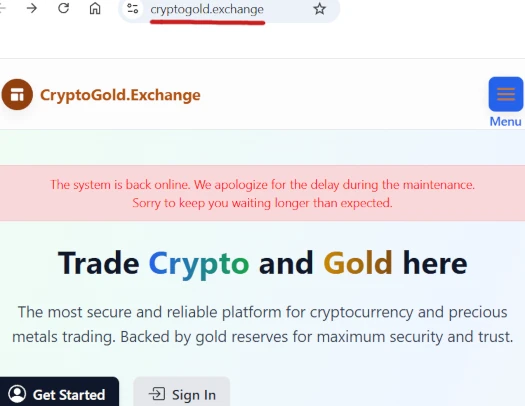
CryptoGold Exchange’s website domain (“cryptogold.exchange”), was privately registered on July 2nd, 2025.
Offsite marketing reveals CryptoGold Exchange citing “Professor Robert” as its President and Founder:

That’s obviously an AI-generated image, and “Professor Robert” also appears in copious amounts of CryptoGold Exchange related AI slop.
I was ready to write Robert off as an AI creation when I came across this photo posted by Miles Segers in December 2025:
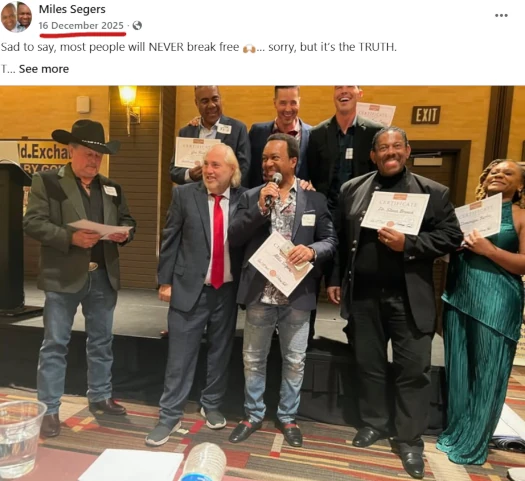
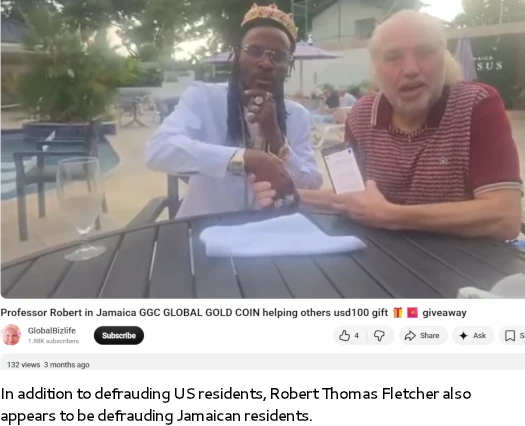
Roberts isn’t named by Segers but it prompted me to dig deeper. I came across this December 2025 YouTube video from Danny de Hek, titled “Global Gold Coin GGC Phone Call with Danny de Hek Vs Professor Robert (Robert Thomas Fletcher)“.
That was enough for me to figure out why we have “Professor Roberts” and AI-generated slop.
On social media Fletcher cites himself as being from Kenai, Alaska but living in Kyiv, Ukraine:
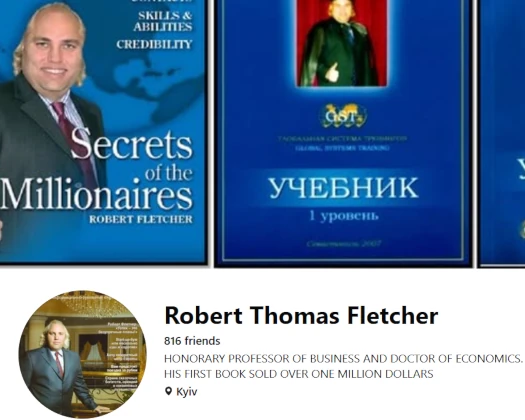
At this point I’d only seen the AI-generated slop, so I was half expecting Fletcher to have a typical eastern European accent. Turns out while there are posts on Fletcher’s FaceBook page in Russian (circa 2016), he does have a North American accent.
Sidenote: I know the premise of the just linked video is absolutely ridiculous but, other than noting Roberts appears to have had a stroke, the “Emperor of Jamaica” is unfortunately beyond the scope of this review.
Getting back to Robert Thomas Fletcher hiding behind “Professor Robert” and AI slop; the SEC filed a federal securities fraud lawsuit against Fletcher and three co-conspirators in September 2007.
Fletcher was ProVision’s chief executive officer, chairman and president from approximately July 2003 until March 2005.
The Commission’s complaint alleges that ProVision and Fletcher fraudulently raised millions of dollars from investors, and then Fletcher used the money for personal expenses and to support his lavish lifestyle, including purchasing jewelry and clothing, and for gambling.
A California federal court ordered Fletcher to pay $5 million is disgorgement and a $130,000 civil money penalty in August 2008. By that point Fletcher had already fled the US.
Fletcher fled the US in June 2006, after ProVision collapsed in 2005 but before the SEC filed suit in 2007. As reported by Kyiv Post in March 2008, Fletcher was arrested by Ukrainian authorities in November 2007.
Fletcher was caught with a fake Ukrainian passport on Nov. 9, 2007, when he attempted to cross into Russia by train. He spent 10 days in jail and was released on bail for $6,400, and later paid a small fine.
In June, the Dniprovsky precinct police station in Kyiv determined that Fletcher had used a fake Ukrainian passport to marry his wife, Olha Dubrovska, in Dnipropetrovsk, in August 2007.
He used the same passport to register his residence in Kyiv on Sept. 29, 2007.
After setting himself up with a wife to maintain residency, Fletcher set about defrauding Ukrainians through Global Systems Trainings, a series of investment scams hidden behind a “Millionaire Mentorship” mentoring scheme.
Ukrainian authorities arrested Fletcher again in November 2008 on suspicion of fraud. Investor losses were pegged at over $10 million.
By 2013 Fletcher’s criminal case had still not proceeded to trial;
Fletcher, 49, and eight Ukrainians are suspected of committing more than $10 million in fraud by promoting fictitious business projects while promising high returns on investments.
Fletcher, in addition, is accused of creating and heading an organized crime group and forgery.
Nearing the five-year mark in jail as legal proceedings against him drag on, Fletcher faces up to 12 years in prison if convicted. Kyiv’s Desniansky District Court is hearing the case expected to last into next year.
With a trial still pending after six years, in February 2015 Fletcher was released on pre-trial bail.
Fletcher’s trial drags on because many victims are difficult to find after so many years, with some having registered addresses in Russian-occupied Crimea and Donbas.
Fletcher’s trial delay is put down to Ukraine’s geopolitical situation at the time – the after-effects of which are still playing out today.
After Fletcher’s release in 2015 the case goes dark, there are no further publicly available records. Fletcher meanwhile has now turned up in the US with CryptoGold Exchange.
As of April 2026, SimilarWeb was tracking ~76,300 monthly CryptoGold Exchange website visits. This is a notable continuing reduction from ~350,000 visits in February.
Over April 2026, top sources of CryptoGold Exchange website traffic were the US (96%) and Indonesia (4%).
US dominance of CryptoGold Exchange brings us to Global Gold Coin (GGC), the crypto token CryptoGold Exchange solicits investment into.
Global Gold Coin is attached to Global Gold Mining Corp Inc., a Nevada shell company, and Global Gold LLC, a Florida shell company.

Unlike CryptoGold Exchange, which is fronted by an AI-generated avatar, several US residents have put their faces to Global Gold Coin.
Global Gold Coin has its own website on the domain “ggccorporate.com”, privately registered on January 16th, 2026.
In an official “presentation deck”, five Global Gold Coin Board of Directors are named:
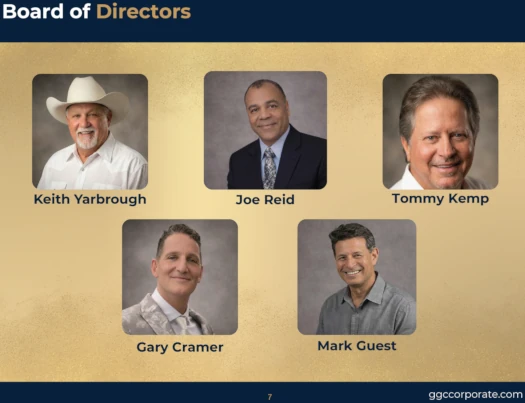
- Keith Yarbrough – Elepreneurs, Vasayo
- Joe Reid – Text Cash Network, GladiaCoin
- Tommy Kemp – recent MLM history unknown
- Gary Cramer (aka Gary Neal Cramer, Gary Neal Cramer) – history of securities fraud
- Mark Guest – recent MLM history unknown
We also have Global Gold Coin’s President’s Advisory Board:
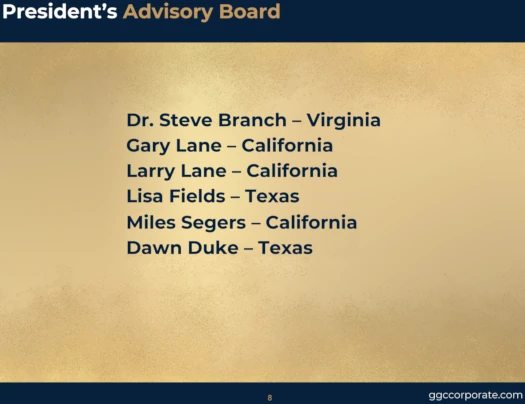
- Steve Branch – Finance Pro, LivePure
- Gary Lane – twin brother of Larry Lane
- Larry Lane – Rippln, B-Epic, VIP Global Stars, VidMe, Beurax, TranzactCard, Nelo Life, LevAI
- Lisa Fields – Nelo Life
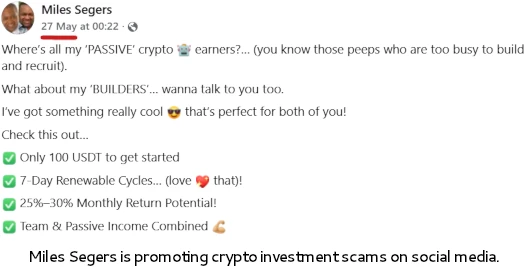
- Miles Segers – 7K Metals, various crypto Ponzi schemes (example see below)
- Dawn Duke – recent MLM history unknown
As always, if an MLM company is not openly upfront about who is running or owns it, think long and hard about joining and/or handing over any money.
CryptoGold Exchange’s Products
CryptoGold Exchange has no retailable products or services.
Promoters are only able to market CryptoGold Exchange promoter membership itself.
CryptoGold Exchange promoters are able to access GGC Academy for $29.99 a month.
The GGC Academy is an optional $29.95/month education platform built around a learn-and-earn model. It provides training on crypto, gold-backed assets, and the GGC ecosystem.
Individual modules within GGC Academy cost between $199 and $999.
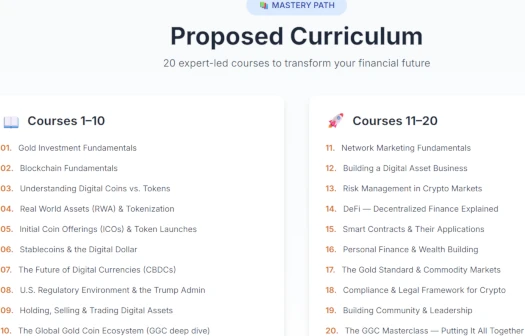
Completion of the modules rewards Crypto Gold Exchange promoters with GGC tokens.
CryptoGold Exchange’s Compensation Plan
CryptoGold Exchange’s compensation plan pays on GGC token investment and GGC Academy subscriptions and module access purchases.
CryptoGold Exchange solicits direct investment in GGC token via tether (USDT) and bitcoin (BTC). Specific pricing is not publicly disclosed.
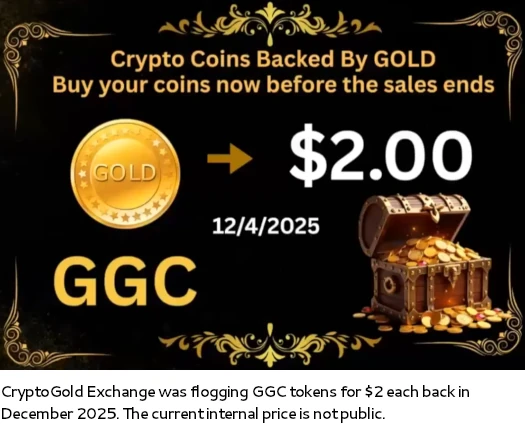
Be it GGC token investment or GGC Academy subscriptions and module access, CryptoGold Exchange pays commissions out via a unilevel compensation structure.
A unilevel compensation structure places a promoter at the top of a unilevel team, with every personally recruited promoter placed directly under them (level 1):
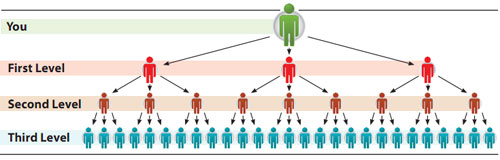
If any level 1 promoters recruit new promoters, they are placed on level 2 of the original promoter’s unilevel team.
If any level 2 promoters recruit new promoters, they are placed on level 3 and so on and so forth down a theoretical infinite number of levels.
CryptoGold Exchange caps payable unilevel team levels at seven.
Referral commissions are paid as a percentage of USDT and BTC investment, as well as GGC Academy fees across these seven levels as follows:
- level 1 (personally recruited promoters) – 20%
- levels 2 to 6 – 5%
- level 7 – 10%
Joining CryptoGold Exchange
CryptoGold Exchange promoter membership is free.
Full participation in the attached income opportunity requires a minimum undisclosed investment in GGC tokens.
GGC tokens can also be obtained through GGC Academy subscription fee payments, costing $29.99 (monthly) to $999 (one-time).
CryptoGold Exchange Conclusion
The marketing ruse behind CryptoGold Exchange is its GGC tokens are backed by gold mining.

The problem is the mining or purported gold backing GGC tokens doesn’t exist. Global Gold Coin admits this in a “presentation deck” on its website:
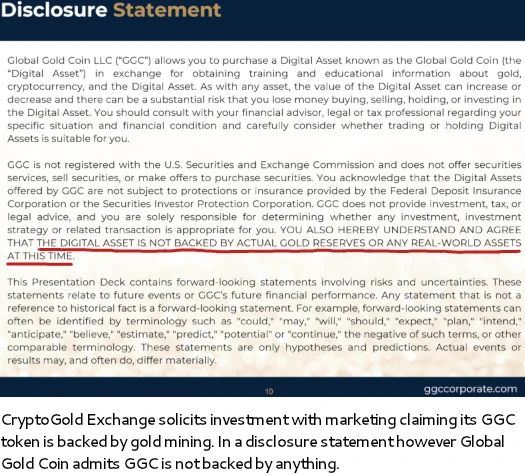
So off the bat we have CryptoGold Exchange soliciting investment into its worthless GGC tokens on a false premise.
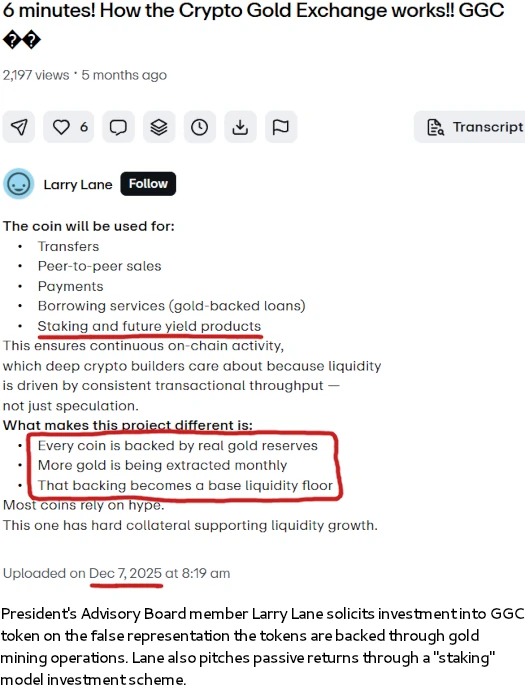
Before we get further into breaking down CryptoGold Exchange as a fraudulent investment scheme, it’s important to point out it’s just a continuation of Robert Fletcher’s prior fraud in the US and Ukraine.
This is from the SEC’s 2007 lawsuit against Fletcher;
This action arises out of Defendant Robert Thomas Fletcher III’s fraudulent operation and management of ProVision Operation Systems, a development-stage company which purportedly offered real estate and business seminars, and also purportedly operated businesses involving yachts, land development, and the mining and processing of a mineral called “humate”.
With CryptoGold Exchange, Fletcher has partnered up with a new group of US resident accomplices to continue defrauding consumers.
- ProVision –> CryptoGold Exchange and Global Gold Coin
- fake land development and mining of “humate” –> fake gold mining
- Millionaire Mentor –> GGC Academy
The material difference is Fletcher is now running his fraud through cryptocurrency.

As with ProVision, the specific type of fraud applicable to CryptoGold Exchange and Global Gold Coin is securities fraud.
The Howey Test is easily satisfied, with CryptoGold Exchange soliciting investment into its GGC token on the expectation of profits, with said profits derived from fictional gold mining operations.
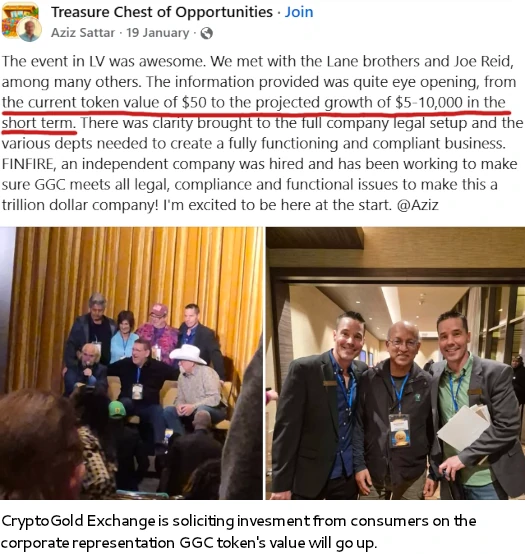
Here I have to point out Fletcher’s 2008 SEC case order included an injunction, explicitly prohibiting further violations of the Securities and Exchange Act.
The orders permanently enjoin Fletcher and ProVision from violating Section 10(b) of the Securities Exchange Act of 1934 and Rule 10b-5 promulgated thereunder, and Sections 17(a), 5(a), and 5(c) of the Securities Act of 1933.
Specific to Washington, Gary Cramer’s DFPI order also prohibits him from committing further acts of securities fraud in Washington.
IT IS HEREBY ORDERED that Cramer, Global SMG and their agents, employees and representatives shall each cease and desist from offering or selling securities in any manner in violation of RCW 21.20.140, the securities registration section of
the Securities Act of Washington.IT IS FURTHER ORDERED that Cramer, Global SMG and their agents, employees and representatives shall each cease and desist from offering or selling securities in any manner in violation of RCW 21.20.040, the securities broker-dealer and securities salesperson registration section of the Securities Act of Washington.
IT IS FURTHER ORDERED that Cramer, Global SMG and their agents, employees and representatives shall each cease and desist from offering or selling securities in any manner in violation of RCW 21.20.010, the anti-fraud section of the Securities Act of Washington.
I’d have said there’s also a case to answer for commodities fraud, but I’m not sure that applies if CryptoGold Exchange admits its tokens aren’t backed by anything as represented (one could make the argument the false representations in marketing is fraud).
As it stands, the only verifiable source of revenue entering CryptoGold Exchange is new investment.
Using new investment to pay GGC token withdrawals would make CryptoGold Exchange a Ponzi scheme.
Additionally, with nothing marketed or sold to retail customers, the MLM side of CryptoGold Exchange operates as a pyramid scheme.

As with all MLM Ponzi schemes, once promoter recruitment dries up so too will new investment.
This will starve CryptoGold Exchange of ROI revenue, eventually prompting a collapse.
From Kyiv Post in 2015;
Although the U.S. Securities and Exchange Commission fined him $5 million for securities fraud in August 2008, Fletcher said he’s learned from his mistakes.
“If you notice, all the rich Ukrainians, they got nothing in their names, it’s all either in their relatives’ names or proxies,” he said.
Math guarantees that when a Ponzi scheme collapses, the majority of participants lose money.
