
TLN Protocol Review: The Last Network Ponzi 2026 reboot
 TLN Protocol fails to provide ownership or executive information on its website.
TLN Protocol operates from the domain (“tlndapp.com”), was privately registered on January 28th, 2026.
TLN Protocol is known to BehindMLM as a failed reboot of The Last Network.
The Last Network was an MLM crypto Ponzi run by Biashara “Bish” Smeir (below).

The Last Network ran its fraudulent investment scheme through VOW token. Vow token is tied to Vow Network, which Smeir launched in 2019 as a reboot of his failed CashbackApp scheme.
Circa 2022 The Last Network and Vow Network were run through Enigmatic Smile, a UK shell company set up by Smeir.
Today there is no mention of Enigmatic Smile on TLN Protocol’s website. Vow Network is now run through The Vow Ecosystem Foundation, a shell company set up in the tax haven Jersey.
Any mention of Smeir on Vow Network’s website has also been scrubbed.
The Last Network collapsed through a “hackers!” exit-scam in August 2024.
At time of collapse, The Last Network’s website domain was “tlnprotocol.com”. Today that domain redirects to TLN Protocol’s “tlndapp.com” domain.
As per TLN Protocol’s website Terms and Conditions;
These Terms & Conditions are governed by the laws of Dubai, United Arab Emirates.
In researching The Last Network in 2024, we noted the involvement of Joerg Wittke:
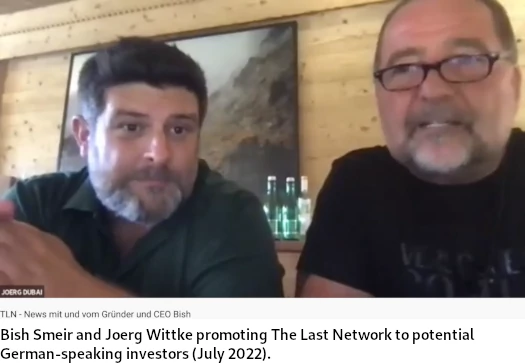
Wittke, a serial promoter of MLM crypto Ponzi schemes, is a German national hiding out in Dubai. Whether Smeir has also fled to Dubai is unclear.
Due to the proliferation of scams and failure to enforce securities fraud regulation, BehindMLM ranks Dubai as the MLM crime capital of the world.
BehindMLM’s guidelines for Dubai are:
- If someone lives in Dubai and approaches you about an MLM opportunity, they’re trying to scam you.
- If an MLM company is based out of or represents it has ties to Dubai, it’s a scam.
If you want to know specifically how this applies to TLN Protocol, read on for a full review.
TLN Protocol’s Products
TLN Protocol has no retailable products or services.
Promoters are only able to market TLN Protocol promoter membership itself.
TLN Protocol’s Compensation Plan
TLN Protocol promoters invest VOW token, tether (USDT) or bitcoin (BTC).
Invested VOW, USDT or BTC is converted into LP tokens. LP tokens are then entered into a “staking” investment scheme for 365 days.
Over the 365 days returns are paid in TLN Gold token. TLN Gold token withdrawals attract a 20% fee, only payable in VOW tokens.
The MLM side of TLN Protocol pays on recruitment of promoter investors.
In violation of consumer protection laws (e.g. the FTC Act in the US), TLN Protocol hides details of its MLM compensation plan from consumers.
All that is disclosed is TLN Protocol discloses is that referral commissions are paid on “liquidity provision” (new investment).
TLN Protocol insists its MLM opportunity isn’t a pyramid scheme, which we’ll explore further in the conclusion of this review.
Joining TLN Protocol
TLN Protocol promoter membership is free.
Full participation in the attached income opportunity requires an undisclosed minimum investment in VOW, USDT or BTC.
TLN Protocol Conclusion
TLN Protocol can be summed as a continuation of the The Last Network Ponzi scheme, with Smeir pretending he isn’t running the scam.
Vow Network is presented with a “foundation” facade. TLN Protocol’s ruse is it’s “a community”;
This site is a community resource, operated by the community for the community.
Instead of being honest about rebooting a collapsed MLM crypto Ponzi scheme with the intent of further defrauding consumers, TLN Protocol provides consumers with erroneous defenses for fraud.
TLN Protocol’s fraud can be defined as unregistered securities, wire fraud and money laundering, which is typical of MLM companies running unregistered investment schemes.
To confirm TLN Protocol’s investment scheme is a securities offering we need to identify an investment contract. This is done through the Howey Test.
For purposes of the Securities Act, an investment contract (undefined by the Act) means a contract, transaction, or scheme whereby a person invests his money in a common enterprise and is led to expect profits solely from the efforts of the promoter or a third party.
TLN Protocol investor (a person), invest their money into a common enterprise (TLN Protocol) on the expectation of an advertised passive return (“expectation of profits”). TLN Protocol claims returns are funded by “trading fees” (“the efforts of others”).
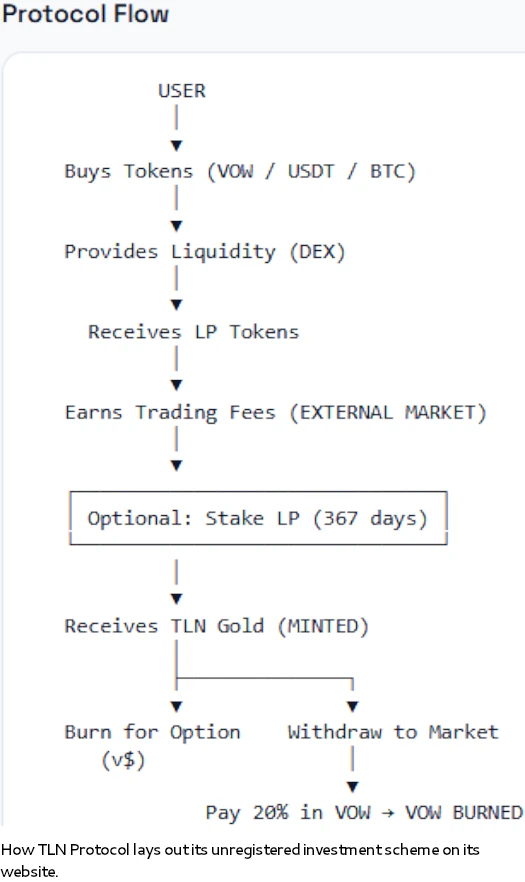
With all prongs of the Howey Test satisfied, TLN Protocol’s investment scheme constitutes an investment contract and is therefore a security.
Neither Vow Network or TLN Protocol are registered to offer securities in any jurisdiction. This is verifiable securities fraud in every jurisdiction TLN Protocol solicits investment in.
Securities fraud is typically regulated by financial regulators through civil fraud charges. Securities fraud can also be criminally charged as wire fraud and typically includes money laundering charges.
TLN Protocol itself acknowledges its investment scheme…
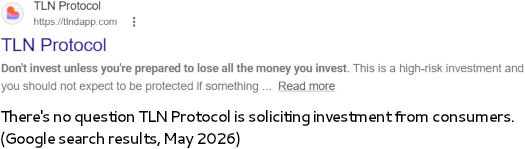
…which makes the pseudo-compliance baloney it provides to consumers even more nonsensical.
Instead of being honest about running a Ponzi scheme and committing securities fraud, TLN Protocol states this on its website;
Is TLN a Ponzi scheme?
No.
A Ponzi scheme pays earlier participants using money from new participants.
TLN Protocol does not do this.
-Users do not deposit money into a central pool
-The protocol does not redistribute funds between users
-Returns are not funded by new entrants
Instead:
-users earn trading fees from external markets
-incentive tokens are minted by the protocol
-all outcomes depend on market conditions
This is structurally different from a Ponzi scheme as defined by the U.S. Securities and Exchange Commission and the Financial Conduct Authority.
TLN Protocol’s pseudo-compliance hinges on relabeling a unregistered securities offering as “a protocol”, which TLN Protocol claims “does not redistribute funds between users”.
This brings us back to TLN Protocol’s purported “trading fees”;
Where do the returns actually come from?
There are two sources:
1. Trading Fees
Users who provide liquidity on platforms like Uniswap or PancakeSwap earn fees from real trading activity.
2. Token Incentives
The protocol mints tokens (TLN Gold and TLNX) as incentives.
-these are not funded by other users
-they have no guaranteed value
-their price is determined by the market
-No returns come from other participants’ capital.
“Token incentives” is crypto bro speak for “we create tokens out of thin air. Cashing out of said tokens within TLN Protocol is funded by the money in TLN Protocol, which brings us back to purported trading fees.
As part of its securities fraud, TLN Protocol has failed to provide financial regulators with periodically filed audited financial reports. These audits are not only a legal requirement, they are the only way for consumers to verify TLN Protocol is paying ROI withdrawals with trading fees.
Under no circumstances is a “trust me bro” guarantee from Ponzi scammers a substitute for registering with financial regulators and periodically filing audited financial reports.
Moving onto the MLM side of TLN Protocol, with nothing marketed or sold to retail customers, it operates as a pyramid scheme.
Again TLN Protocol plies consumers with pseudo-compliance to explain away its fraud;
Isn’t the referral system a pyramid scheme?
No.
In a pyramid scheme:
-income depends primarily on recruitment
-money flows from new participants to earlier participants
In TLN:
-rewards are triggered by liquidity provision (real activity)
-no funds are transferred between participants
-rewards are minted by the protocol
The system rewards activity, not recruitment.
“Liquidity provision” is new investment, which in TLN Protocol is tied to recruitment of new promoter investors.
In TLN Protocol everyone signs up as a promoter with access to the investment opportunity and MLM compensation plan. There are no retail customer investors.
“No funds are transferred between participants” is a meaningless statement. New promoters sign up, invest into TLN Protocol and TLN Protocol takes a percentage of that investment to pay MLM commissions.
Similarly, so too is “rewards are minted by the protocol”. Whether TLN Protocol creates tokens out of thin air to pay MLM commissions is neither here nor there with respect to it being a pyramid scheme.
Finally, we have TLN’s take on regulation;
Is TLN Protocol regulated?
TLN Protocol operates in the decentralized finance (DeFi) space, which is still evolving from a regulatory perspective.
Users should consider guidance from local authorities like the Financial Conduct Authority when assessing risk.
This I actually agree with. If you’re wondering why TLN Protocol is citing the UK’s FCA, it’s likely due to Bish Smeir being a UK national (Scotland).
Specific to the UK and FCA, MLM crypto schemes with “refer a friend” bonuses (i.e. MLM), were made illegal in 2023.
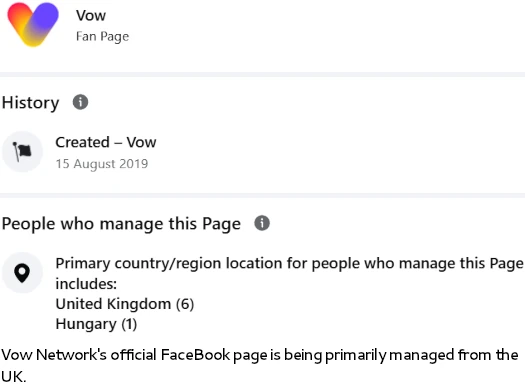
But by all means, as TLN Protocol suggests, contact the FCA regarding Smeir operating TLN Protocol illegally in the UK. Let us know how that goes in the comments below.
As it stands, the only verifiable source of revenue entering TLN Protocol is new investment.
Using new investment to pay ROI withdrawals (through whatever BEP-20 shit tokens Smeir has created), would make TLN Protocol a Ponzi scheme.
As with all MLM Ponzi schemes, once promoter recruitment dries up so too will new investment.
This will starve TLN Protocol of ROI revenue, eventually prompting a collapse.
Look no further than The Last Network to see this in action – along with subsequent investor losses.
