
FTC secures Forever Living Products income claims injunction
 Earlier this month Forever Living Products abruptly terminated MLM operations in the US.
Instead of being honest about why it was shutting down, Forever Living Products issued a vague statement about “unforeseeable restrictions”.
These restrictions include ongoing monitoring and structural requirements that make operating the current U.S. model impossible without introducing broader regulatory risk.
Now the FTC has revealed Forever Living agreed to a deceptive income claims injunction prior to shutting down.
Forever Living Products is an aloe vera themed MLM company founded by Rex Maughan in 1978.
 Maughan passed away in 2021. Today Forever Living Products is fronted by CEO Gregg Maughan (right).
As alleged by the FTC in a Complaint filed on April 13th, Forever Living Products has
long used a variety of deceptive earnings claims to market their MLM opportunity.
These include claims of unlimited income, testimonials from purportedly successful participants, images of luxury goods or lifestyles, and images of participants holding giant checks for thousands, tens of thousands, or hundreds of thousands of dollars.
The FTC states that, even after becoming aware of the FTC’s investigation, Forever Living Products continued to violate the FTC Act.
Although Defendants have modified some of these claims since becoming aware of the FTC’s investigation, to this day Defendants continue to make specific claims of significant income and continue to represent that consumers who pursue Defendants’ MLM opportunity will or are likely to make a profit in the endeavor, including through unqualified claims that FBOs make “extra income” or “supplemental income,” as well as other deceptive earnings claims.
Other claims from Forever Living Products appear to spell out a classic MLM pyramid scheme;
Defendants also frequently claim that FBOs will or are likely to receive income based on the purchases or sales made by other
consumers whom they recruit to join as FBOs.
The FTC alleges the end result of Forever Living Products’ marketing is FBOs (promoters) “will or are likely to make a profit.”
This is in contrast to data obtained from Forever Living Products, which shows
the vast majority of consumers pursuing the MLM opportunity incur expenses (indeed, Defendants encourage them to do so) but receive no income from Forever Living.
In other words, these consumers lose money—the exact opposite of what Defendants advertise.
Based on Forever Living’s own public representations about FBOs’ 2024 earnings, of 23,000 U.S. FBOs who engaged with the Forever MLM business that year, nearly 77% received no income from Defendants and another 15.4% received less than $206, total, before expenses.
Less than 8% of U.S. FBOs received $206 or more in total annual income from Defendants, before expenses.
The FTC’s analysis of data produced by Forever Living shows that the prior four years were similar or worse.
The FTC’s analysis of data produced by Forever Living shows that of consumers who became FBOs (requiring a purchase of more than $300), in their first year most (71.7%) received no income from Defendants and the vast majority (90.9%) received less than $300 in total for the year.
Even after two full years as FBOs, the overwhelming majority — more than 89.2% — still had not recouped their initial $300-plus start-up cost, with 68.9% receiving no income from Defendants for the entire two-year period.
And most FBOs do not receive income based on the purchases or sales made by their downline, either.
The FTC’s analysis of data produced by Forever Living shows that in 2023, of 22,238 U.S.
FBOs who made a purchase or sale or sponsored a new FBO, only 7% received income from Defendants based on the purchases or sales made by their downline (another 10.6% received commissions when customers they referred made purchases from Defendants online, and the rest—82.4%—received no income from Defendants).
Statistics for prior years are similar. And even fewer U.S. FBOs received such income on a consistent basis.
For example, in 2023 only 413 (1.9%) of the 22,238 U.S. FBOs received at least $100 per month from Defendants based on the purchases or sales made by their downline in at least half of all months.
A tiny percentage—only 250, or 1.1%—received at least $100 per month from the purchases or sales made by their downline in every month.
Going hand in hand with Forever Living Products’ deceptive income claims is little to no focus on retail sales.
While consumers pursuing the MLM opportunity could hypothetically earn income through in-person retail sales, Defendants do not track such sales and have no reasonable basis to believe that they produce income sufficient to offset the expenses these consumers incur in pursuing the business opportunity, much less produce a profit.
A “preferred customer” in MLM is where a retail customers commit to a monthly order in exchange for a discount. In Forever Living Products, the preferred customer class was little more than a recruitment funnel.
Defendants’ data show that between January 2020 and October 2022, the vast majority (at least 16,471) of over 19,000 U.S. Preferred Customers became FBOs, and the average tenure of a U.S. Preferred Customer was less than 2 months.
This evidence suggests that few consumers are purchasing Forever Living products consistently for consumption and independent of the opportunity to participate in the MLM.
Forever Living Products being unable to retain retail customers for even two months is a damning indictment on the retail viability of its product range.
With all of the above in mind, the FTC concluded Forever Living Products’
deceptive practices violate the FTC Act, and Defendants’ conduct has caused significant harm to the American people.
Rather than defend its deceptive conduct, Forever Living Products consented to an injunction.
As per the injunction, granted on April 14th, Forever Living Products is prohibited from making unsubstantiated income claims and/or misrepresentations.
The injunction also sees Forever Living Products ordered to email its US promoters, backdated to January 2023, disclosing settlement with the FTC.
Additionally,
Within 15 days of entry of this Order, Corporate Defendants must post a prominent link to an exact copy of the form shown in Attachment A on the landing page of the portion of their website for U.S. Participants.
For reference, the attached Form A:
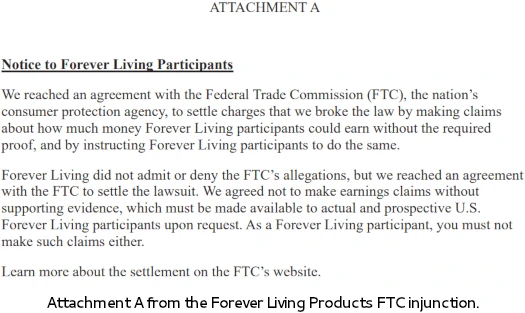
This brings us to Forever Living Products terminating MLM operations in the US.
To be clear, Forever Living Products wasn’t ordered to terminate MLM operations. Forever Living Products was absolutely able to continue MLM operations in the US without deceptive income claims.
Instead it chose to shut down, presumably on the basis Forever Living Products as an MLM company isn’t viable without deceptive income claims marketing.
Forever Living Products might have also determined continued operation of what is quite obviously an MLM pyramid scheme, would sooner or later result in further action from the FTC (it’s unclear whether this came up in pre-injunction discussions between the parties).
BehindMLM reviewed Forever Living Products in 2013, raising concerns about autoship recruitment at the cost of retail.
The weak point of Forever Living Products’ business model was that of the possibility that retail can be ignored and the opportunity can be reduced to a $132 a month recruitment focused scheme.
Based on the data the FTC obtained, it seems like that’s exactly what was going on.
While Forever Living Products has committed to continuing acts of deception and harming consumers outside of the US, participants and potential participants in those countries should take note.
SimilarWeb tracked ~1.5 million visits to Forever Living Products’ website in March 2026.
Top sources of website traffic across the same period were India (17%), Hungary (16%) and the US (15%).
Update 28th April 2026 – Indian authorities have arrested Forever Living Products’ Country Sales Manager.

I was with Forever Living for close to 20 years as a customer and distributor, although I haven’t been active for the past few years. I made a little money with them but admittedly my marketing expenses exceeded my profits. But in their defense, FLP never misled me with fake promises of riches.
What I really liked about them was their focus on product sales. Even in the local and regional member recruiting meetings I attended, the focus was on the products. (Ozedit: snip, see below)
Here’s the problem with personal anecdotes and why they’re meaningless;
“I’ve been with Forever Living for 69 years. I was recruited on the promise of riches. I lost money.”
Means about as much as your story. What matters is evidence, which the FTC collected and forms the basis of their Complaint.
Notwithstanding if Forever Living Products wasn’t a pyramid scheme built on deceptive income claims, they’d legally have no issue with compliance monitoring, for the thing you claim they don’t do, and continue to operate in the US.
If you want to live in denial fantasy land that’s fine – but you yourself at least admitted to getting sucked into Forever Living’s MLM opportunity and losing money.
The thing about scamming people is the best scammers do it in a way where their marks don’t realize they’re being scammed. Hell some of them, even when confronted with evidence, might even pop up to defend the scam.
I’d say I hope you learned something from your loss in Forever Living Products but I think we already know the answer to that.
I really don’t know why you’re being hateful (Ozedit: derails removed)
I’m not going to get in a back and forth war with you on this. But suffice to say that you shouldn’t tell people they didn’t experience what they experienced unless you’ve got firsthand knowledge.
Whatever BS you learnt at Forever Living Products won’t work here.
Facts aren’t hateful. Try again without the emotional manipulation.
There’s nothing to get into a back and forth about. I’m not doubting you got sucked into the Forever Living Products pyramid scheme and lost money – you admitted as much.
Whether you continued to throw good money after the bad upon realizing you’d been scammed is neither here nor there. My point was your personal anecdote is meaningless – evidence matters and the FTC had so much of it that Forever Living Products opted to cease defrauding consumers in the US.
The business wasn’t viable on retail sales. Not that that matters in your instance as you signed up for the MLM opportunity.
Only one reason people sign up for an MLM opportunity – income. In your instance it wasn’t there so that brings us back to square one.
Sorry for your loss.
This is good news and absolutely shows Forever Living for what it is. I only wish that FLP was required to share this information in a formal way in other countries.
I have found my way into the U.K. private FBOs’ group and there is nothing there except for a step up in pressure to be your own best customer and, above all, recruit. Any mention is immediately deleted.
The U.K. FBOs I’ve spoken to deny all knowledge, but I guess none of them want to acknowledge how fragile things are. Neither do they want to acknowledge what is frankly a confession by the bosses of FLP about how they have misled people.
So here in the U.K. it’s business as usual, the same income lies and lifestyle lies and the same push to recruit for a career style income.
It is a bit sad to see the US adopt the China “don’t scam our people but it’s OK to scam everyone else” approach. Especially when it’s a US company in question.
It is.
The country leader in UK is busy pushing a 30 day ‘aloe challenge’ to FBOs, making claims about gut health, and pushing tickets to a ‘Success Day’ where no doubt everyone will get to hear about career-level incomes and financial freedom with impunity.