
FTC sues Amare Global for bogus mental wellness claims
 Amare Global’s “the mental wellness company” and “mentabiotics” nonsense has caught the attention of the FTC.
In a Complaint filed in California on June 2nd, the FTC accuses Amare Global of using bogus health claims to market its products. Deceptive earnings claims are also cited.
BehindMLM last reviewed Amare Global in February 2023. The company goes in hard on mental wellness, whilst failing to provide evidence to support any of its health claims.
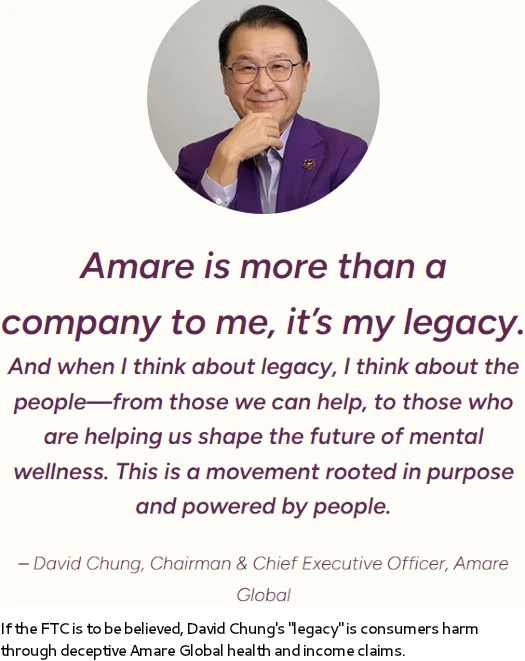
As of February 2023 Amare Global was headed up by founder Hiep Tran and CEO Jared Turner. In January 2024 Amare Global was purchased by David C. Chung.
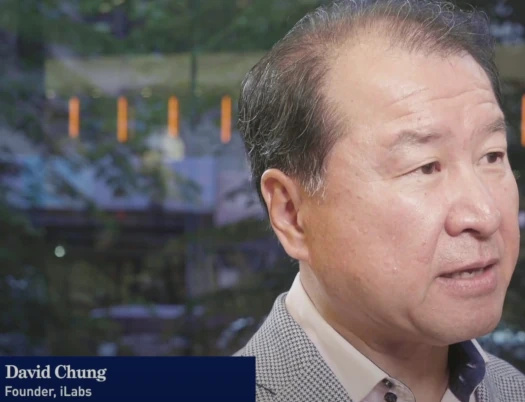
Chung installed himself as Chairman and CEO. Neither Tran or Turner appear to still be with Amare Global.
The FTC’s lawsuit names Amare Global Holdings, INC., Shawn Talbott, David Chung and Patrick Hintze as defendants.
From the FTC’s Complaint;
Amare represents that its products will provide various health benefits, including treatment of certain diseases and conditions, both in children and adults.
Amare, both directly and through its brand partners, promote the products on social media such as Instagram, TikTok, Facebook, or YouTube, claim three of Amare’s most popular products the Happy Juice Pack (a combination of supplements), Kids Mood+, and Kids Happy Juicework across the gut-brain axis to increase or normalize neurotransmitters like serotonin, dopamine, and Gamma-aminobutyric acid (GABA), while decreasing or regulating hormones like cortisol.
They also claim these functions cause the products to improve the symptoms of a range of mental conditions including depression, anxiety, and ADHD.
All of these claims are false, misleading, or not substantiated.
The FTC’s position is Amare Global’s entire “mental wellness company” marketing angle is baloney. The root of Amare Global’s bogus health claims is attributed to Shawn Talbott;
Defendants’ claims about their products’ effects on neurotransmitters and hormones originated with Talbott, who formulated Amare’s products and personally made claims relating to their purported ability to regulate neurotransmitters and hormones.
When pitching Happy Juice, Talbott claimed the product works in so many different ways to improve overall mental wellness, stating it lowers cortisol and raises different neurotransmitters like serotonin, that helps with happiness, and dopamine, that helps with motivation, and GABA for stress reduction and relaxation.
When pitching Kids Mood+, Talbott claimed the product has been shown to modulate neurotransmitters.
For example, he claims it helps normalize serotonin and dopamine activity the “feel good” neurotransmitters and [b]alances stress hormones (cortisol).
At an April 2018 Amare Global marketing event hosted by Patrick Hitnze, Talbott presented Amare Global’s supplements as an alternative to disease treatments;
On or about April 19, 2018, Hintze hosted a launch tour event, which was reposted on Vimeo, where Talbott presented.
In the video Talbott displayed an Amare-branded slide with a graphic titled where are you on the mental wellness continuum showing a scale from 1-10, with a disease status on the left, which listed depression, anxiety, ADD/ADHD, and Alzheimer’s.
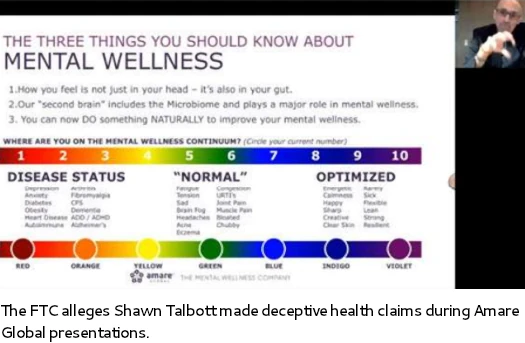
The middle of the chart reads, Normal, and the right-hand side of the chart reads optimized, which includes feeling happy and resilient.
Talbott states that no matter where you are on the continuum, Amare will help you towards the optimized side of the continuum.
(talbott mental welness video SS)
Shortly thereafter, Talbott presented a slide depicting the antidepressants Prozac, Lexapro, and Celexa, along with energy drink and coffee brands, noting these substances are what people typically “reach for” when “struggling” with mental health issues.
Talbott says that instead people need “something that really gets in and addresses all the things that might be out of balance, and that’s what we’re going to talk about tonight.”
Talbott proceeded to discuss Amare products such as the FundaMentals Pack, which contains MentaBiotics (a component in Amare’s Happy Juice pack, which was introduced in 2021).
On or about February 11, 2020, Talbott posted a video to his YouTube page showing his appearance on an ABC News Los Angeles affiliate program from December 2019.
In the segment, Talbott appears in a shirt with an Amare logo and explains that the saffron extract used in Kids Mood+ “can help with depression in teenagers, equivalent to Prozac.”
Amare also made this video available to brand partners for sharing on its portal for brand partners.
In another 2024 ad, Talbott appears in a video posted on Amare.com, noting a purported scientific paradigm shift, where scientists believe you should treat the gut to get results in the brain; while he speaks, different traditional drugs/treatments, including “antidepressants”, appear on the screen.
The video implies that Amare’s products can replace these traditional treatments.
In 2024, Happy Juice’s packaging stated, “THE KEY INGREDIENTS IN HAPPY JUICE ARE SHOWN TO: increase positive mood +105%.”
From Talbott, bogus health claims spread throughout Amare Global.
Amare has made similar claims on its website about Happy Juice and Kids Mood+, for example representing that Happy Juice “[i]ncreases natural serotonin, dopamine, and GABA production, and that Kids Mood+ normalizes neurotransmitter activity, including serotonin and dopamine in the brain, support[s] healthy cortisol levels, and reduce[s] stress hormones.”
Brand partners frequently repeat and elaborate on these claims, sometimes by quantifying the amount by which Amare’s products will lower depression (by 50 or 55%), increase positive mood (by 211%), or decrease negative mood (confoundingly, by 105%).
Several examples from promoters are cited;
On or about November 30, 2022, an Amare brand partner claimed there are “[o]ver 100 Clinical Study Results for Happy Juice, and it lower[s] cortisol exposure and improves GABA neurotransmission and increase[es] serotonin.”
She elaborated that Happy Juice caused a “55% DECREASE in ANXIETY scores”, a “50% DECREASE in DEPRESSION scores,” a “105% DECREASE in NEGATIVE MOOD” and a “211% INCREASE in POSITIVE MOOD.” (emphasis in original)
On or about December 29, 2025, an Amare brand partner claimed her “body had unlevel serotonin + dopamine communication & high cortisol” and was “craving dopamine, serotonin and GABA.”
She claimed these issues resolved after she found “an all natural probiotic drink that actually helps the body naturally create ALL of the neurotransmitters & hormones I needed via the GUT”, elaborating “after 2 weeks I was weaning myself off of my anti anxiety meds. I’m no[w] three years med free!”
On or about July 4, 2024, an Amare brand partner claimed “one drink can: lower cortisol . . . increase serotonin, dopamine & GABA production to [i]mprove mental health.”
In the caption, she stated, “About 90% of our serotonin, the primary neurotransmitter responsible for happiness and mood, is actually produced and located in our gut. Gut health IS mental health.
This supplement drink supports the growth and vitality of specific strains of gut bacteria to increase the production of those “feel good” neurotransmitters so you literally feel happier as you continue to drink it and heal your gut.”
She included the hashtags “#HappyJuice,” “#MentalHealth,” “#MentalWellness,” “#Cortisol,” “#Anxiousness,” and “#AnxiousFeelings” on the post.
On or about January 7, 2025, an Amare brand partner claimed when she started her children on the same supplements she was using for her and her husband (Happy Juice), “but formulated for kids,” (Kids Happy Juice), her “house transformed” because “these supps work the gut-brain axis[,] [g]etting the serotonin and dopamine in the gut communicating with the brain.”
She concluded, “This product doesn’t just mask symptoms: it addresses the root by regulating those key brain chemicals.”
On or about August 7, 2024, an Amare brand partner posted a video with the words, “[Y]ou’ve had 4 kids it’s just genetics your [sic] big boned[.] [L]owering the cortisol enters the chat[.] [L]ost 50 lbs[,] all my inflammation[,] and have never felt better.”
In her caption, this brand partner wrote, “[M]ake sure you are following me and comment 555 for my gut health protocol to lower cortisol[.]”
She continued, it “helped my mental wellness, curbed my sugar cravings, better sleep and transformed me.”
At the extreme end of the spectrum (no pun intended), Amare Global promoters pitched supplements as a suicide preventative;
On or about January 7, 2025, an Amare brand partner claimed in a video she no longer needed medications for suicidal ideations because of Happy Juice.
On or about October 24, 2024, an Amare brand partner posted a picture of three children with the following text on top of it:
“The 2nd leading cause of death for children is suicide. That is not ok. Here[‘]s [sic] 5 tips to help your kids achieve mental wellness and bring happiness back! There [sic] life could depend on it!”
In the caption, one of five tips she offers is to “Focus on GUT & BRAIN health” and then states the “Mental Wellness Company just launched . . . the world[‘]s FIRST pre & probiotic drink with specific strains [of] bacteria to replenish the gut bacteria that is being stripped from a child’s gut due to poor diet.”
After saying “[t]he results parents are seeing is awesome,” she offers “coupons [for] $10-30 off our KIDS HAPPY JUICE!”
She concludes with the keywords, “kids mental wellness cortisol ADD ADHD focus.”
On or about August 20, 2024, an Amare brand partner claimed on her social media page that drinking Happy Juice allowed her to stop taking medications:
“See ya 250 Zoloft & adhd meds! Hello sex drive back, & life without debilitating anxiety!”
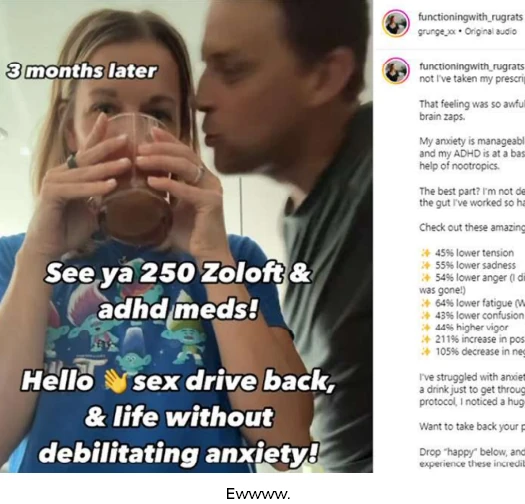
She elaborated, “I’m no longer bound by whether or not I’ve taken my prescription that day or if I’m waiting on a refill[,]” and stated “I’m not dealing with prescriptions that wrecked the gut I’ve worked so hard to heal.”
She also referenced that “with the help of the nootropics,” her anxiety and ADHD are now “manageable” despite having “struggled with anxiety [her] whole adult life.”
She claims to have noticed a huge shift around day 27 on this protocol.
Claims regarding anxiety, ADHD are also cited. A disturbingly significant number of cited examples pertain to minors.
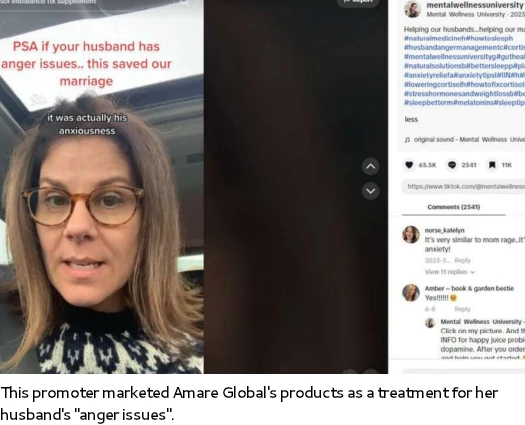
Part of the FTC’s investigation saw it go “undercover” and speak directly with Amare Global promoters;
One brand partner during a call to an FTC undercover investigator posing as a prospective brand partner, explaining sellers are obviously not allowed to say those medical terms online because it’s illegal per, like, the government, but, you know, you just have to find different words around it.
Talbott describes such tactics as engaging in word play in a YouTube video he published about making dietary supplement claims.
Similarly, in addition to making explicit both depression and mood claims referenced above, brand partners sometimes describe Amare products relieving symptoms of depression rather than using the terms depression or depressed.
While he didn’t found the Amare Global, post-acquisition David Chung fit right into Amare Global’s culture of deceptive marketing claims.
Chung knew Amare lacked appropriate substantiation for the company’s marketing claims.
At the July 2024 company-sponsored convention, Chung explicitly acknowledged the lack of substantiation for not just the ingredients but the finished products. Despite this knowledge, Chung did not direct the company to cease sales of its products.
The FTC attributed Chung’s deception to Amare Global’s sales growth, particularly in its Happy Juice and Kids Mood+ supplements.
On deceptive income claims the FTC writes;
Defendants have long used a variety of deceptive earnings claims to entice consumers to become brand partners, including through brand partners in Founding Brand Partner Defendant Hintze’s downline.
Amare’s brand partners claim they operate seven-figure businesses. They post on social media that anyone can join Amare by following simple steps to make, at a minimum, $500 a month, to supplement or replace their current income, even if they do not have a large social media following or prior MLM experience.
However, from January 2021 through December 2024, only [redacted] of brand partners made $500 per month or more; an income disclosure statement available on Amare’s website at least through April 2026 indicates a typical brand partner brings in just $25 per month before expenses.
Amare is aware of this repeated and widespread conduct and has allowed it to continue, even rewarding and highlighting many of the brand partners making the most extreme and deceptive statements.
I have to note there are substantial paragraphs of redactions in the FTC’s Complaint. A subsequent filing reveals this was done as a precaution as the information cited was disclosed to the FTC by the Amare Global defendants.
The FTC has requested the redactions be in place for seven days, pending any objections from the Amare Global defendants. If there aren’t any, presumably an unredacted Complaint will be filed.
While I can’t speak to the paragraphs of redactions, figures such as the redacted percentage above don’t mask the substance of the FTC’s allegations.
In the above quoted instance, the redacted percentage of Amare Global Brand Partners who make $500 or more a month is assumed to be appallingly low.
Specific to defendants Shawn Talbott and Patrick Hintze, the FTC notes they both have prior FTC orders in place.
Amare’s misconduct is particularly egregious given that since its formation in 2017, Amare’s leadership has included two key players who are already subject to prior court-ordered permanent injunctions prohibiting them from making false, misleading, or unsubstantiated claims.
The first, Shawn Talbott, a defendant in FTC v. Window Rock Enterprises, Inc. … was Amare’s Chief Science Officer from the company’s inception until he resigned in October 2024. He has been subject to an FTC Order since 2005.
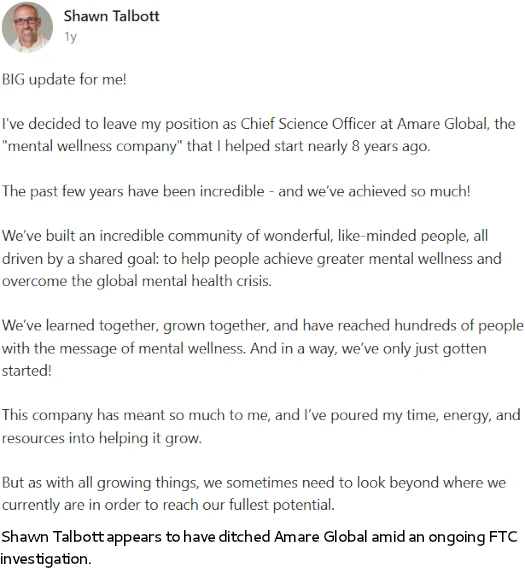
Talbotts’ misconduct was detailed in BehindMLM’s original Amare Global review (2019).
Notwithstanding the fact that he is subject to an FTC Order prohibiting false or unsubstantiated health claims, Defendant Talbott personally made many of the company’s deceptive health claims.
Note that while Talbot resigned as Chief Science Officer, the FTC’s Complaint asserts Talbott was still a part owner in Amare Global as of March 2025.
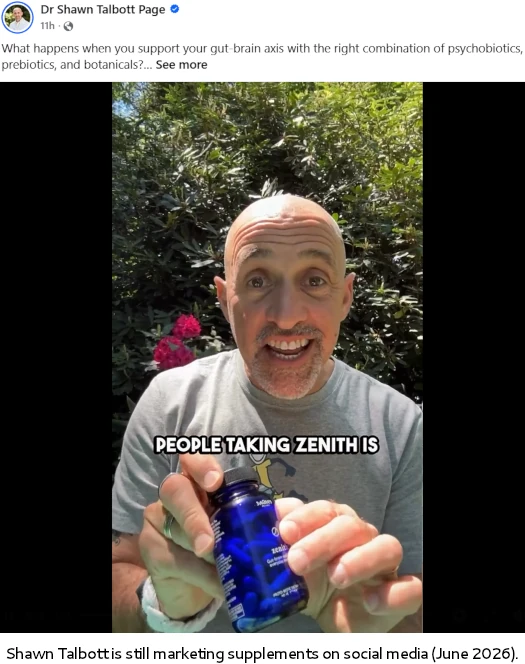
It’s unclear whether, as of June 2026, Talbott still has an ownership stake in Amare Global.
The second, Patrick Hintze, a defendant in FTC v. Green Foot Global … is the company’s Founding Brand Partner and heads Amare’s multi-level sales structure. He has been subject to an FTC Order since 2013.
Greenfoot Global was a fuel tab MLM scheme launched in 2009. Greenfoot Global settled deceptive marketing claims allegations with the FTC for $800,000 in 2013. Patrick Hintze was a named defendant in the case.

Things get a bit messy here as, while the FTC is pursuing new claims against Amare Global, it also intends to revisit Talbott’s Window Rock Enterprises case;
On the Window Rock docket, shortly after filing this Complaint, the FTC intends to file a motion to hold Talbott, Amare, Hintze, and Amare’s founding CEO Hiep Tran in contempt for violating Talbott’s final order by making false, misleading, or unsubstantiated health claims.
As of yet there’s nothing on the Window Rock Enterprises case docket. I am noting however that the case was closed via order back in 2007. Then there’s a jump to 2024, wherein an FTC attorney sought permission to represent the FTC in the case.
While not confirmed, this strongly indicates the FTC began its Amare Global investigation around 2024.
While BehindMLM took issue with Amare Global’s “mentabiotics” baloney, the question of whether it was a pyramid scheme was left open-ended.
From our 2021 review;
Personal autoship is acceptable but only if there’s at least 100 PV a month in retail sales volume to match. If your potential upline is just on 100 PV a month autoship and looking to recruit others who do the same, that affiliate is running their Amare Global business as a pyramid scheme.
Based on information it obtained via subpoena, the FTC appears to have confirmed Amare Global operates as a pyramid scheme.
Since 2017, Amare has sold almost all of its products through its brand partners. Between September 2017, when the company began selling products, through December 2024, Amare made [redacted] of its monthly sales through brand partners.
Reflective of it being an MLM pyramid scheme, the vast majority of Amare Global promoters made less than $500 annually.
Only a tiny percentage of brand partners make at least $500 in revenues per month ($6,000 per year).
According to Amare’s income disclosure statement, which was available on Amare’s website at least through April 2026, 86% of people made just $25 per month ($300 per year), before any expenses.
“Before expenses” is crucial, as it’s highly likely Amare Global promoters who made $25 spent more than that monthly.
Expenses often include the purchase of a product in a month to remain eligible for commissions.
As part of pseudo-compliance, the FTC notes Amare Global had a non-functioning compliance department;
Despite its awareness, Amare’s compliance department does not take meaningful action to prevent or remove deceptive posts like those described throughout this complaint, which direct consumers to Amare’s website to purchase products or become a brand partner.
Amare regularly fails to take any other disciplinary action against brand partners for making false or unsubstantiated health claims about its products, such as freezing their commissions, disabling their credentials, or suspending or terminating them from the network.
Brand partners’ deceptive claims often remained online for days, weeks, months, and even years, and the brand partners who made them including those described in this Complaint continued to market Amare’s products.
Indeed, rather than taking reasonable steps to stop deceptive claims, Amare promoted brand partners who made themincluding brand partners whose claims Amare recognized violated the company’s policies.
Summing up its Complaint, the FTC states;
Based on the facts and violations of law alleged in this Complaint, the FTC has reason to believe that Defendants are violating or are about to violate laws enforced by the Commission because, among other things:
a. Amare and its brand partners continue to disseminate the claims described above, even though the company is aware of an FTC investigation into the company’s health and income claims;
b. Defendants have engaged in their unlawful acts and practices willfully and knowingly, and with knowledge of Talbott’s order, which prohibits (1) making health claims without competent and reliable scientific evidence to back them, and (2) misrepresenting the results of studies;
c. Amare’s revenues exceed [redacted] from participating in these unlawful acts and practices, and Defendants Amare, Talbott, Chung, and Hintze continue to profit from the claims’ continued occurrence and their direct or indirect ownership of Amare (Chung, Talbott) and status as founding brand partner (Hintze);
d. Defendants have continued their unlawful acts or practices for years despite knowledge of unsubstantiated claims being made;
e. Defendants’ unlawful acts and practices were the subject of prior law enforcement actions against other companies of which Defendants Amare, Talbott, and Hintze were aware, yet Defendants have continued to engage in such practices; and
f. Defendants remain in the multi-level marketing and direct selling business and maintain the means, ability, and incentive to resume their unlawful conduct
Across three counts, the FTC goes on to accuse the Amare Global defendants of multiple violations of the FTC Act:
- deceptive health claims
- deceptive income claims
- means and instrumentalities
Consumers are suffering, have suffered, and will continue to suffer substantial injury as a result of Defendants’ violations of the FTC Act.
Absent injunctive relief by this Court, Defendants are likely to continue to injure consumers and harm the public interest.
The FTC is seeking an injunction as well as unspecified “additional relief”. Whether “additional relief” includes monetary penalties is unclear. Typically these are explicitly requested.
Stay tuned for updates as BehindMLM continues to track the FTC’s Amare Global lawsuit.
