
Sweden & Norway target Zinzino illegal medical claims
 Regulators in Sweden and Norway have targeted Zinzino for misleading and deceptive marketing claims.
Back in March 2026 Sweden’s Konsumentverket (KO, english: Swedish Consumer Agency), banned several marketing claims made in relation to Zinzino’s supplements.
The two claims pertained to Zinzino’s Viva+ saffron supplement and BalanceOil+.

According to KO, Zinzino promoters are marketing its saffron supplement as a replacement for antidepressant medication.
A Zinzino promoter marketed the MLM opportunity on the basis BalanceOil+ “helped her get pregnant”.
KO states neither claim is backed by scientific evidence;
When it comes to health-related claims, marketing demands are particularly high. The company behind the marketing must be able to present accepted scientific evidence that is convincing.
Zinzino attempted to weasel out of responsibility by claiming it wasn’t responsible for claims its promoters made. KO was having none of it.
Zinzino emphasizes that their partners are contractually obligated to follow the rules of the Marketing Act. The violations instead concern partners who have not followed Zinzino’s instructions on how their products are allowed to be marketed.
Zinzino is, however, primarily responsible for how its partners market the company’s products. Because the violations were so serious, KO has chosen to issue a ban on the current marketing.
The ban, effective March 2026, sees Zinzino subject to fines of 1.5 million SEK per violation if the deceptive marketing continues (~$160,000 USD).
A June 2nd report from Finansavisen reveals similar regulatory action taking place in Norway.
The Norwegian Food Safety Authority believes that Zinzino’s marketing is both misleading and likely to create fear.
In March this year, the Norwegian Food Safety Authority conducted an inspection of Zinzino.
During the inspection, the Norwegian Food Safety Authority uncovered several violations of the claims regulations, and examples of what the Authority believes to be misleading marketing.
Three citations were issued. Zinzino challenged the citations but the Food Safety Authority rejected them.
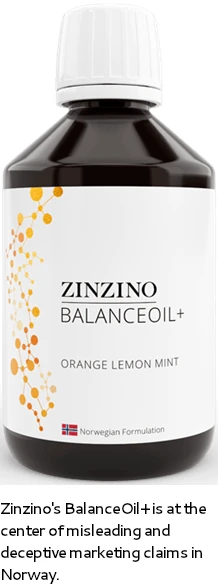 As in Sweden, Zinzino’s deceptive marketing claims in Norway pertain to its BalanceOil+ supplement.
“We still consider that parts of their marketing give the impression that Balance Oil has properties in the form of improving, preventing and relieving pain and illness. This is a serious and clear violation of regulatory requirements,” one of the decisions states.
And further: “You imply in your marketing that a balanced and varied diet does not provide sufficient nutrition. And exploit consumers’ fears by referring to adverse changes in physiological functions.”
Zinzino has been ordered to address identified deceptive marketing practices on its website by August 17th.
In addition, the Authority has decided that non-specific health claims must be closely related to an approved health claim.
Last year BehindMLM took a look into Zinzino’s recent MLM acquisitions.
In April 2025 Zinzino filed its 2024 annual report. From the report we can see back in 2020 Zinzino’s total revenue was 1.1 billion SEK (~118 million USD). That’s since climbed to 2.2 billion SEK in 2024 (~236.1 million USD).
Net profit is a bit less impressive growth wise, coming in at 169.3 million SEK for 2024 ($18.1 million), up from 164 million SEK in 2023 (~17.6 million USD).
For Zinzino’s last reported quarter, Q2 2025, the company reported a 57% quarter on quarter increase. Net profit for the quarter was 55.4 million SEK ($5.9 million USD).
On May 22nd, Zinzino published a financial report for the first quarter of 2026;
Revenue for the first quarter of 2026 amounted to SEK 922.1 (723.7) million, representing 27% (59%) growth compared to the corresponding period last year.
Zinzino’s financial growth continues to sound impressive but if said growth is built on deceptive marketing claims, this could pose a problem for the company in the future.
As of April 2026 SimilarWeb was tracking ~445,000 monthly visits to Zinzino’s website.
Top sources of website traffic over the same period were Germany (26%), the US (10%), Hungary (8%), Colombia (7%) and Mexico (7%).
