
Orange Cat Energy Review: Charging station “click a button” Ponzi
 Orange Cat Energy fails to provide ownership or executive information on its website.
Orange Cat Energy operates from two known website domains:
- orangecatenergy.net (marketing) – registered in April 2025, private registration last updated on March 14th, 2026
- orangecatenergy.cc (app) – registered in April 2025, private registration last updated on March 15th, 2026
As per its website Privacy Policy, Orange Cat Energy’s owner is:
Orange Cat Energy Technology Co., Ltd.) – (Room 5031, 5/F, Yau Lee Centre, 45 Hoi Yuen Road, Kwun Tong, Hong Kong.
This Hong Kong address is an industrial hub that has nothing to do with Orange Cat Energy.
While it appears to be targeting Europeans (Germany in particular), official Orange Cat Energy marketing shows Google services in Chinese:

This suggests whoever is running Orange Cat Energy has ties to China.
As always, if an MLM company is not openly upfront about who is running or owns it, think long and hard about joining and/or handing over any money.
Orange Cat Energy’s Products
Orange Cat Energy has no retailable products or services.
Promoters are only able to market Orange Cat Energy promoter membership itself.
Orange Cat Energy’s Compensation Plan
Orange Cat Energy promoters invest tether (USDT). This is done on the promise of a daily return:
- ZD-D04 – invest 120 USDT and receive 1 to 4 USDT a day
- ZD-D08 – invest 300 USDT and receive 5 to 10 USDT a day
- ZD-D08P – invest 700 USDT and receive 12 to 25 USDT a day
- ZD-D16P – invest 1600 USDT and receive 40 to 60 USDT a day
- ZD-G24 – invest 3488 USDT and receive 80 to 130 USDT a day
- ZD-G48 – invest 7209 USDT and receive 230 to 300 USDT a day
Orange Cat Energy pays referral commissions on USDT investment down three levels of recruitment (unilevel):
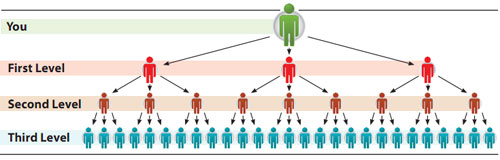
- level 1 (personally recruited promoters) – 6%
- level 2 – 3%
- level 3 – 1%
Joining Orange Cat Energy
Orange Cat Energy promoter membership is free.
Full participation in the attached income opportunity requires a minimum 120 USDT investment.
Orange Cat Energy Conclusion
Orange Cat Energy is yet another “click a button” app Ponzi scheme.
Orange Cat Energy’s “click a button” Ponzi ruse is device charging stations.

The assigned task in Orange Cat Energy is “scanning codes to rent” charging stations. This sees Orange Cat Energy affiliate investors log in daily to “click a button”.

Clicking the button daily qualifies Orange Cat Energy investors to receive advertised daily returns.
Beyond that clicking a button inside Orange Cat Energy does nothing. There is no external revenue; all Orange Cat Energy does is recycle newly invested funds to pay earlier investors.
Orange Cat Energy is part of a group of “click a button” app Ponzis that emerged in late 2021.
Examples of already collapsed “click a button” app Ponzis using the same charging station ruse are Simo Power, TRX ChargePoint and Blink Charging.
Since 2021 BehindMLM has documented hundreds of “click a button” app Ponzis. Most of them last a few weeks to a few months before collapsing.
“Click a button” app Ponzis disappear by disabling both their websites and app. This tends to happen without notice, leaving the majority of investors with a loss (inevitable Ponzi math).
In the lead up to a collapse, “click a button” Ponzi investors also tend to find their accounts locked. This typically coincides with a withdrawal request.
As part of a collapse, “click a button” Ponzi scammers often initiate recovery scams. This sees the scammers demand investors pay a fee to access funds and/or re enable withdrawals.
If any payments are made withdrawals remain disabled or the scammers cease communication.
Organized crime interests from China operate scam factories behind “click a button” Ponzis from south-east Asian countries.
In September 2024, the US Department of Treasury sanctioned Cambodian politician Ly Yong Phat over ties to Chinese human trafficking scam factories.
Through various companies he owns, Phat is alleged to shelter Chinese scammers operating out of Cambodia.
Myanmar claims to have deported over 50,000 Chinese scam factory scammers since October 2023. With “click a button” app scams continuing to feature on BehindMLM though, it is clearly not enough.
In late January 2025, Chinese ministry representatives visited Thailand. The stated aim of the visit was to tackle organized Chinese crime gangs operating from Myanmar.
In early February 2025, Thailand announced it had cut power, internet access and petrol supplies to Chinese scam factories operating across its border with Myanmar.
As of February 20th, Thai and Chinese authorities claim ten thousand trafficked hostages had been freed from Myanmar compounds.
Also on February 20th, five Chinese crime bosses were nabbed in a wider raid of four hundred and fifty arrests in the Philippines.
On March 19th it was reported that, despite the recent raids and arrests, “up to 100,000 people” are still working in Chinese Myanmar scam factories.
As of April 2025 and in response to a crackdown across Asia, newly opened Chinese scam factories have been reported in Nigeria, Angola and Brazil.
Myawaddy is an area in Myanmar along the Thai border. Myawaddy is under the control of the Karen National Army (KNA).
The KNA, led by warlord Chit Thu (right) and sons Saw Htoo Eh Moo and Saw Chit Chit, protect and profit from organized Chinese criminals running “click a button” Ponzi scam factories.
 On May 5th the US imposed sanctions on Chit Thu (right).
The Treasury said the warlord, Saw Chit Thu, is a central figure in a network of illicit and highly lucrative cyberscam operations targeting Americans.
The move puts financial sanctions on Saw Chit Thu, the Karen National Army that he heads, and his two sons, Saw Htoo Eh Moo and Saw Chit Chit, the department said in a statement, freezing any U.S. assets they may hold and generally barring Americans from doing business with them.
Britain and the European Union have already imposed sanctions on Saw Chit Thu.
A May 25th report cites Myanmar and Loas as having “towering scam economies”. Cambodia however is reported to be a hotspot for Chinese criminal activity.
Cambodia is likely the absolute global epicentre of next-gen transnational fraud in 2025 and is certainly the country most primed for explosive growth going forward.
Cambodia is becoming the centre of an exploding global scam economy driven primarily by Chinese organised crime.
Chinese gangs are reported to operate in Cambodia under the protection of unnamed local politicians.
In June 2025, Amnesty International claimed Cambodia’s government was
“deliberately ignoring” abuses by cybercrime gangs who have trafficked people from across the world, including children, into slavery at brutal scam compounds.
The London-based group said in a report that it had identified 53 scam centres and dozens more suspected sites across the country, including the Southeast Asian nation’s capital, Phnom Penh.
The prison-like compounds were ringed by high fences with razor wire, guarded by armed men and staffed by trafficking victims forced to defraud people across the globe, it said, with those inside subjected to punishments including shocks from electric batons, confinement in dark rooms and beatings.
In July 2025 Cambodia arrested over 1000 cybercrime suspects. Twenty-seven of those arrested were members of Chinese criminal gangs.
In October 2025 US authorities announced the indictment of Chen Zhi, founder and Chairman of Prince Holding Group.
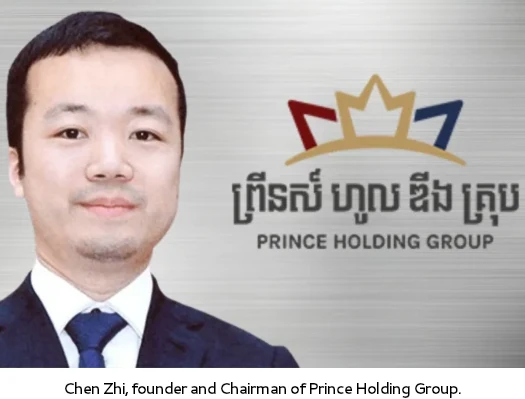
Zhi, originally from China but having obtained Cambodian citizenship at some point, is accused of being the “mastermind” behind Chinese organized crime operations in Cambodia.
“As alleged, the defendant was the mastermind behind a sprawling cyber-fraud empire operating under the Prince Group umbrella, a criminal enterprise built on human suffering.
Trafficked workers were confined in prison-like compounds and forced to carry out online scams on an industrial scale, preying on thousands worldwide, including many here in the United States,” said Assistant Attorney General for National Security John A. Eisenberg.
Individuals held against their will in the compounds engaged in cryptocurrency investment fraud schemes, known as “pig butchering” scams, that stole billions of dollars from victims in the United States and around the world.
Cambodia doesn’t have an extradition treaty with the US. As at time of publication, Chen Zhi remains at large.
On October 20th, Myanmar authorities announced seizure of thirty Starlink devices, used to provide internet services to scam compounds operating from KK Park.
KK Park is a notorious Chinese-run scam district operating from within Myanmar near the Thailand border.
On October 22nd Vorapak Tanyawong, Thailand’s deputy finance minister, resigned over alleged bribery from Chinese organized crime groups.
The “Whale Hunting” newsletter alleged that Vorapak’s wife was paid US$3 million in cryptocurrency this year by Chinese-Cambodian criminal networks that he was tasked to investigate as part of a government committee.
On October 31st Singapore announced it has seized $115 million tied to Chen Zhi’s Prince Group.
On November 3rd, Myanmar authorities announced they had been bombing buildings in KK Park for nine days. The bombings coincided with the arrest of 1600 foreigners fleeing the compound.
As of Monday morning 1,598 had been detained, 265 of them women, he said. An informed source said they came from 28 countries.
Prince Holding Group’s Chen Zhi was arrested in Cambodia in early January 2026.
Zhi was promptly extradited to China, where he faces criminal charges related to “operating casinos, fraud, illegal business operations and concealing criminal proceeds”.

On March 13th, 2026, Cambodia announced it had drafted its first law targeting online scam centers.
Regardless of which country they operate from, ultimately the same group of Chinese scammers are believed to be behind the “click a button” app Ponzi plague.
Update 7th April 2026 – Orange Cat Energy has collapsed.

During my research in February, I found three additional website domains.
orangecatenergy.org – privately registered on April 19, 2025, and last updated on March 14, 2026.
orangecatenergy.org currently redirects to orangecatenergy.com.
postimg.cc/4Y5yJ40m
orangecatenergy.vip – also privately registered on April 19, 2025, and last updated on December 6, 2025.
postimg.cc/LqsZZZKp
orangecatenergy.com – privately registered on July 25, 2025, and last updated on December 1, 2025.
postimg.cc/wRT9vDsq
On February 12, 2026, German serial fraudster Bernd Reinders from Bocholt posted the following chart on Facebook. It lists the amounts in euros and also includes the new ZD-G 120 charging station for 16,000 euros, with a daily return of 640 to 750 euros.
Condition (*) for the ZD-G24 charging station.
Condition (**) for the ZD-G48 charging station.
postimg.cc/sMcbcmwd
facebook.com/photo/?fbid=4907314526161990&set=a.1685119825048159
There are now four (!) companies involved in the Orange Cat Energy scam.
1. Orange Cat Energy Technology Co., Limited in Hong Kong, founded in April 2025. The CEO is Jihui Zhuang, a 37-year-old Chinese national, but he looks much younger in this photo.
postimg.cc/Mvh5pC6Y
2. Orange Cat Energy Technology Investment Limited, incorporated on September 23, 2025, in London. The director is also Jihui Zhuang.
postimg.cc/jwv74Z5q + postimg.cc/mcyzT87N
find-and-update.company-information.service.gov.uk/company/16735781
and
find-and-update.company-information.service.gov.uk/company/16735781/officers
3. Orange Cat Energy GmbH in Hechingen (Germany). The company was founded on October 15, 2025. Bernd M. Slowaczek is the managing director.
postimg.cc/T5wCVyTC
northdata.de/Orange%20cat%20energy%20GmbH,%20Hechingen/Amtsgericht%20Stuttgart%20HRB%20802112
4. Orange Cat Energy Technology Limited, incorporated on November 25, 2025, in Southwick (UK). The director is the Ghanaian Samuel Ofori.
postimg.cc/XG3CSthv + postimg.cc/WF2hfgF3
find-and-update.company-information.service.gov.uk/company/16735781
and
find-and-update.company-information.service.gov.uk/company/16873731/officers
Bernd M. Slowaczek, the managing director of Orange Cat Energy GmbH in Hechingen whom I mentioned in my last comment, has a criminal record for fraud. I described this in that comment.
https://behindmlm.com/mlm-reviews/skainet-systems-review-ai-trading-bot-ruse-dubai-ponzi/#comment-496464
Thanks for the additional research. “Click a button” Ponzi schemes are notorious for changing investment amounts and ROI rates.
Because of this you’ll find different rates advertised by different promoters at different times (rank and file promoters don’t stick around for long once they realize accounts that request large withdrawals are locked).
Björn Haaken from Höltinghausen, Germany, registered the domain orangecatenergy.eu on December 18, 2025.
postimg.cc/qh8kYhJ1
whois.eurid.eu/en/search/?domain=orangecatenergy.eu
In his imprint, Björn Haaken describes himself as a sole proprietor, but his company, CatchUp Media, cannot be found in any registry.
postimg.cc/hJmzDG4R
orangecatenergy-3vk925nxxq.live-website.com/impressum/
Björn Haaken is one of five administrators of the public Facebook group OrangeCat Energy.
postimg.cc/WqDSYX32
facebook.com/groups/1401214871673855/user/61562996645471
The group was created on October 25, 2025, and has 719 members.
postimg.cc/YjJxqN0G
facebook.com/groups/orangecatenergy/
A press release by Björn Haaken dated January 2, 2026.
postimg.cc/r0FkhhHp + postimg.cc/sMTkXLRC
openpr.de/news/1300098/Orange-Cat-Energy-Verdienen-mit-shared-Powerbank-Ladestationen-nach-Amoebenprinzip.html
On November 15, 2025, Björn Haaken uploaded a short video to his new YouTube channel.
postimg.cc/VS0hDL2X
youtube.com/watch?v=JqQdUtDwebA
A commenter (@khaledkhiri3400) criticized the video and asked several questions, but Björn Haaken did not answer any of them.
Much more interesting is the question posed by the German serial scammer Mario Emmrich (@honivox) under this video. It seems he also wants to actively participate in this scam.
postimg.cc/vxWFX72N
Björn Haaken didn’t answer this question either.
Heinz Peter, the notorious serial scammer from Dornbirn, Austria, promotes the Orange Cat Energy scam on his own website. The following excerpt shows that webinars are held every Wednesday and Friday at 6 p.m.
postimg.cc/kBpkRpBy
orange-cat.my.canva.site
Heinz Peter’s imprint.
postimg.cc/21N7tQtd
drive.google.com/file/d/1ofY0KXDdejJ23icf3d3wek4wFeRDSWfj/view
Heinz Peter on Telegram.
postimg.cc/18p1xK36
t.me/heinzpeter61
Video featuring Heinz Peter from January 3, 2026.
postimg.cc/Y4tpSPvs
youtube.com/watch?v=mvrexdJfG0U
Heinz Peter’s playlist featuring 7 videos for Orange Cat Energy on YouTube.
postimg.cc/Fkz6Cy7D
youtube.com/playlist?list=PLzGiwIBOGGEP8OSzsbfOOE1AXvfnfG2jn
In the past, Heinz Peter has promoted the following fraudulent schemes: DCPTG, JokerX, BlackFort, ROXXTTER CLUB, Boomerang, and MHT Trading.
His 10-year-old website belohndichselbst.net is currently unavailable, even though the domain registration was updated on March 18, 2026.
postimg.cc/FkmS94Mn
Heinz Peter on Facebook with 5,985 followers. His new website cannot be accessed via this link: orange-cat.my.canv. 😀
The correct name is orange-cat.my.canva.site.
postimg.cc/vDVbWK18
facebook.com/Belohndichselbst
Spelling is a major problem for this lousy scammer. I notice this regularly on his websites and on Facebook. He lives in Dornbirn, but he spells it Dornbrin.
postimg.cc/vxDmw7bX
The German serial fraudster Uwe Klemm is now also advertising Orange Cat Energy on his website and on YouTube.
postimg.cc/D4h6wcx8
orangecat.wirelesslifestyle.de
Uwe Klemm’s imprint.
postimg.cc/bs0nPtDW
wirelesslifestyle.de/impressum/
Video from January 12, 2026.
postimg.cc/KRQnLTGj
youtube.com/watch?v=K3SW-40BqL8
Video from January 25, 2026.
postimg.cc/bGq9hxRh
youtube.com/watch?v=k6bK0cxsWcw
I have already described Uwe Klemm’s activities in this comment dated February 12, 2026.
https://behindmlm.com/companies/bitnest-collapses-desperate-node-ponzi-reboots/#comment-496380
This review mentioned the websites orangecatenergy.cc and orangecatenergy.net, but there is a third website:
orangecatenergy.store
The domain orangecatenergy.store was privately registered on October 19, 2025, and updated on November 10, 2025.
postimg.cc/njvWsjwd
The imprint on orangecatenergy.store lists three names but no phone number. This is highly unusual in Germany.
Bernd Slowaczek. He is the managing director of Orange Cat Energy GmbH in Hechingen (Germany), founded on October 15, 2025 (see comment #3).
Liviu Roman and Carlton Li are not German names, and I cannot find any information about these two individuals.
postimg.cc/2V6ftGKH
orangecatenergy.store/policies/legal-notice
The orangecatenergy.store website only has visitors from Germany.
postimg.cc/t15y14vZ
The same applies to the orangecatenergy.net website.
postimg.cc/yDGpL4JP
The orangecatenergy.cc website has 98.84% of its visitors from Germany and 1.16% from Croatia. Why did this website have 838,600 visitors in February 2026? I can’t find a plausible explanation for this.
postimg.cc/n9HMgWjb
I found a fourth German website with lots of photos:
691dab9a4150b.site123.me
In addition to the contact information from Germany, there is a contact form in Chinese characters, and the email address includes a Chinese name.
postimg.cc/jL4T5hgt
I suspect this is a translated website from China or Hong Kong, as it also mentions and shows four executives (the CEO, the director of the planning department, and two managers) from OrangeCat Energy Technology Co., Ltd.
postimg.cc/4Ht9t07y
Thomas Daus from Germany promotes LiveGood, Nowsite, At Cost Metals, AkashX, Cryptex/Bytnex, Robex AI, Save Club, and ZeusTrader on his YouTube channel, which has 2,100 subscribers; since February 2026, he has also been promoting Orange Cat Energy with four videos.
postimg.cc/2LY7R4MQ
youtube.com/@ThomasDaus/videos
Video from February 11, 2026.
postimg.cc/jCmcYx8S
youtube.com/watch?v=-v5HkSUQFC4
On LinkedIn, Thomas Daus describes himself as a full-time entrepreneur and network marketing professional since 2014.
postimg.cc/nMgfMjFF + postimg.cc/FkJq0p9w
linkedin.com/in/thomas-daus-11808884/
Orange Cat Energy on Telegram with 13.1K subscribers. This is the official account.
postimg.cc/5H1Gww6B
t.me/s/OrangeCatEnergietechnologieCoLtd
Addition to comment #2.
Bernd Reinders, a serial scammer from Bocholt, Germany, has been promoting the Orange Cat Energy scam on YouTube since January 15, 2026, with 17 videos.
postimg.cc/8sRMPqV4
youtube.com/@orange-cat-energy-powerbank/videos
He hasn’t deleted his old videos about the BitNest scam from this channel yet. Here is an excerpt.
postimg.cc/bZMXshC6
Bernd Reinders provides a link to his personal website, om-r.de, which contains only a 13-page PDF with his registration link for Orange Cat Energy.
postimg.cc/dL9Pqt1y
om-r.de/orange-cat-energy
Bernd Reinders describes himself as a graduate engineer, but he has been a notorious MLM promoter for many years. His om-r.de website has been online since October 2003.
web.archive.org/web/20031023133209/http://www.om-r.de/
His imprint on his om-r.de website.
postimg.cc/1VGSxjy1
His is-r.de website has been online since February 2001.
web.archive.org/web/20010224050221/http://www.is-r.de/
We know Bernd Reinders in connection with OneCoin, BitNest, Skainet, CannerGrow/Cannerald, Ad Pack Pro, Plus Token Wallet, etc.
His Instagram account, which has 152 posts, has 2,003 followers, but it’s private. Why? Aren’t we supposed to see what lies he’s spreading there?
postimg.cc/tYgGDnpF
instagram.com/berndreinders
Bernd Reinders on Facebook with 6,082 followers.
postimg.cc/v1Hd2PRs
facebook.com/bernd.reinders.3
Bernd Reinders also links to orangecat1100 on Telegram.
postimg.cc/gLHTY9Qw
t.me/orangecat1100
On July 25, 2025, someone privately registered the domain orangecatenergy.com and updated it on December 1, 2025.
postimg.cc/75rQ0H8h
I can’t access this website because my antivirus program is blocking it.
postimg.cc/jwCrmxjC
Screenshot from the Web Archive dated March 8, 2026.
postimg.cc/dLjSRMqG
web.archive.org/web/20260308063258/https://orangecatenergy.com
A guy who goes by the name of Paul and supposedly lives in Turkey posted a link to this mysterious website on YouTube in October 2025. “Paul” speaks German, but he has significant trouble with German spelling.
“Paul” has been promoting the Orange Cat Energy scam with 20 videos since October 13, 2025.
postimg.cc/rdptz4mT
On his YouTube channel, “Paul” also recommends Bitget, JTO Token, Bitmart, CT Pool, Bull Power Algo V6, and Roboforex.
youtube.com/@paulstradingtv/videos
“Paul’s” YouTube channel, which has 5,390 subscribers, has been around since April 2016, but the oldest video is from July 2, 2023. How many fraudulent videos has he deleted in the meantime? Why doesn’t he give his full name?
Two photos of this scammer.
postimg.cc/pp0KtxRd + postimg.cc/9wmwvgkF
Announcement from the German Federal Financial Supervisory Authority (BaFin) dated April 2, 2026.
postimg.cc/t7TByfbj
bafin.de/SharedDocs/Veroeffentlichungen/DE/Verbrauchermitteilung/weitere/2026/meldung_2026_04_02_orange_cat_energy_technology_co_ltd.html
Orange Cat Energy has stopped payouts?
@noema6123 commented on YouTube today:
@tech_NICK23, the anonymous operator of the YouTube channel “Invest für jedermann” (Investing for Everyone), replied:
postimg.cc/30phtNNm
youtube.com/watch?v=HRKV4K9dzAQ
P.S.: I just noticed that this scammer (@tech_NICK23) has deleted his three videos promoting the Orange Cat Energy scam. The videos were still up this morning!
For the past week, he’s also been promoting the Arbcore scam with a video.
postimg.cc/4nSk9zLc
youtube.com/@tech_NICK23
Addition to comment #14.
“Paul” from Turkey posted the following comment on his YouTube channel today. Partial quote.
This comment is posted below today’s video.
postimg.cc/gXRs2L0v
youtube.com/watch?v=X4EB1cI8oVM&lc=Ugyigpm0Orch9nKJylt4AaABAg.AVFlAO-1O2wAVFvtUof35i
In addition, “Paul” links to this Telegram account with 1,198 members, where victims of OrangeCatEnergy are supposedly being helped.
postimg.cc/Lqq5fzLt
t.me/+iCyGzJZr7jRhZWQy
Hello and a wonderful good day, dear Melanie. I myself believed in orangecatenergy because I saw the branches in Germany and additionally saw under this link that the Stuttgart District Court released orangecatenergy in the commercial register, and I thought it could be legitimate because branches were founded and the authorities approved it.
I had previously looked at people’s comments where only good things were said, and I invested myself, and orangecatenergy also did not give me any advertising money.
Why did I delete the videos earlier? This is the reason: I found out or heard from … have and my subscribers can definitely tell you that because they have all watched my videos.
I warned everyone and said that it is a normal project and has no guarantee for tomorrow and additionally added this text DISCLAIMER: (Ozedit: snip, see below)
What on earth else could I mention? And after I found out that it was fraud or misinformation according to BaFin, I also immediately reacted and told my subscribers that BaFin had issued a letter and additionally that nothing should be paid. As you can see, I again tried to protect my subscribers with this.
I mean, who is stupid enough to commit fraud and still show their face? I have no fears because everything from my side was done correctly, and as I said, I didn’t know that OrangeCatEnergy intended to defraud people with the branches because I am not a clairvoyant, and nobody could have known this beforehand either, because the controllers are in the hands of the fraudsters, and I can only give a warning, nothing more.
Moreover, Bitget is very big, or Roboforex is also reputable—I have said or done nothing wrong! I will hire a lawyer.because they falsely accused me and additionally used my picture without my permission.
I photographed everything as evidence and I additionally photographed the approval from the Stuttgart District Court because they gave the permission for it in the commercial register.
With kind regards
The most honest and best channel
Pauls Trading Tv
German authorities didn’t approve anything. Chinese scammers registering a shell company with bullshit details is meaningless.
What you didn’t do is anything that mattered. Securities in Germany are regulated by BaFin. Would have taken you five minutes to verify Orange Cat Energy wasn’t registered to offer securities in Germany.
That’s on you. And just so we’re clear, you didn’t create Orange Cat Energy but promoting unregistered securities offerings is still illegal.
You cannot disclaimer your way out of securities fraud. “This is not financial advice” and the other bullshit scammers say on social media is not a legal defense, it means absolutely nothing in court.
All Ponzi schemes collapse and all Ponzi schemes result in the majority of participants losing money. Orange Cat Energy collapsing because it’s a Ponzi scheme was predictable by anyone not looking to scam people for a quick buck.
Whether Bitget or Roboforex are big or not has nothing to do with them being reputable. Again you can verify securities fraud in a few minutes but choose not to. Willfully scamming people into fraudulent investment schemes is the opposite of “doing nothing wrong”.
Spare us the excuses Paul, you recruited people into a Ponzi scheme and now they’re screwed.
I did not persuade anyone to invest in orangecatenergy and spoke clearly about the risks on the internet. I invested myself and did not make a profit in the end because the company did nonsense.
And I also did not know whether it was a Ponzi or pyramid scheme, and if the documents are illegal or forged, then it is the fault of the departments that do not delete such things immediately, and we humans then come and can see everything on the internet. (Ozedit: derails removed)
You have a YouTube channel and Telegram group promoting Ponzi schemes like Orange Cat Energy. Stop lying and own your thievery.
You knew, you just didn’t give a shit while there was money to steal. Stop lying and own your thievery.
The only thing worse than a Ponzi promoter is a scumbag Ponzi promoter who pretends they didn’t know exactly what they were doing. Your victims deserve better.
I am a content creator on YouTube and, like everyone, I am an investor. I always talk on my channel to my subscribers, advising them to invest in such projects by taking risks and not to invest large amounts.
My followers also know that nothing is risk-free. So honestly, those who enter do so by taking risks, and I did not know that this was a Ponzi or anything else because everything looked professional.
No one can deceive anyone; I am also an investor like everyone else. I do not want to argue further with you about this matter because those who know me, know. Regards
Sure. You’re also a promoter of Ponzi schemes who contributes to financial losses by recruiting people into scams.
Whether “your followers” know the scams you promote are “risk-free” is neither here nor there.
You’re a fuckwit if you’re investing in scams because they “looked professional”. You’re an absolute fuckwit if you’re recruiting people into scams you’ve done zero actual due-diligence on.
And just so we’re clear, I’m not arguing with you. I’m calling you on your bullshit. I have no patience for your “I didn’t know!” arguments and justifications for fraud.
Stop making excuses for being a scumbag and own your thievery Paul. Your victims deserve better.
Addition to comment #7.
Heinz Peter from Dornbirn, Austria, has deleted all Orange Cat Energy videos from his YouTube channel, which had a total of 942 views.
postimg.cc/CzdcWjr1
youtube.com/playlist?list=PLzGiwIBOGGEP8OSzsbfOOE1AXvfnfG2jn
Heinz Peter’s new website for the Orange Cat Energy scam is also no longer available.
postimg.cc/S2hZ3RJr
orange-cat.my.canva.site
Heinz Peter’s advertisement for the Orange Cat Energy scam is still up on Facebook.
postimg.cc/SYGHD8dK
facebook.com/Belohndichselbst
Video from April 4, 2026.
This review by BehindMLM can also be seen in the video.
postimg.cc/R3LXC5tH
youtube.com/watch?v=OUyUQce8sVc
Addition to comment #12.
The content of the Telegram channel OrangeCatEnergietechnologieCoLtd has been deleted.
Post from April 7, 2026.
postimg.cc/p9SvJLPN
t.me/s/OrangeCatEnergietechnologieCoLtd
Addition to comment #6.
Björn Haaken‘s orangecatenergy.eu website is no longer accessible, but the imprint is still available. 😀
postimg.cc/hJmzDG4R
orangecatenergy-3vk925nxxq.live-website.com/impressum/
He hasn’t taken down his video from November 15, 2025, yet.
postimg.cc/YGWjzRq8
youtube.com/watch?v=JqQdUtDwebA
Maybe Björn Haaken will answer questions from victims of this scam on Telegram?
t.me/bjoern3675
Addition to comment #9.
This scam is still being advertised on the orangecatenergy.store website. A 5% discount is being offered on the first hire-purchase agreement through April 29, 2026.
postimg.cc/9DLZdfFJ
orangecatenergy.store
A link on this website leads to instagram.com/orangecatenergy_offiziell, but this account has already been deleted.
Addition to comments #6 and 27.
The German Facebook group OrangeCat Energy – Geld verdienen mit shared Powerbank Ladestationen (OrangeCat Energy – Earn Money with Shared Powerbank Charging Stations), which has 1,008 members, was renamed today by admin Björn Haaken.
The new name is:
postimg.cc/mtWFH5C8 + postimg.cc/Z0rGTWcz
facebook.com/groups/orangecatenergy
or
facebook.com/groups/1401214871673855/
Addition to comments #3, 4, and 9.
I finally found a photo of Bernd M. Slowaczek. 😀 He was the leading German promoter who founded his company, Orange cat energy GmbH, in Hechingen on October 15, 2025.
His website for this scam was orangecatenergy.net, which is no longer accessible.
This photo of him was posted on Facebook yesterday.
postimg.cc/LY9XFVN6
facebook.com/groups/1401214871673855
Bernd M. Slowaczek features this photo on Instagram, but the account, which has 638 followers, is empty. Did he delete all the content?
postimg.cc/f3B6r7FQ + postimg.cc/mPTpWz7g
instagram.com/berslowa
A 16-year-old photo of him on Facebook. This account hasn’t been updated since November 2011.
postimg.cc/zy8rVfYz
facebook.com/photo/?fbid=123044571065881&set=ecnf.100000810169767
facebook.com/p/Bernd-Slowaczek-100000810169767/
Another photo with the German Orange Cat Energy scammer Bernd M. Slowaczek (left) from Hechingen.
postimg.cc/4ndLLnjz
instagram.com/p/DWR-d3iiC33/
Bernd M. Slowaczek from Hechingen has not yet deleted his Facebook account, Orange cat energy GmbH, which has 1,458 followers. The man in the photo is not Slowaczek, but Kai René Schumacher from Mühlhausen, who has also founded his own company for Orange Cat.
postimg.cc/9DqWW3C5 + postimg.cc/94KgCSmt
facebook.com/profile.php?id=61583499487259
In a video from November 30, 2025, he mentions his website, orangecatenergy.cv, which is no longer accessible.
postimg.cc/1gB6KVTK
The domain orangecatenergy.cv was registered on November 24, 2025.
postimg.cc/xJzSGMpb
Addition to comment #8.
Uwe Klemm has now marked the two Orange Cat Energy videos I mentioned as “private.”
Partial quote from his website.
postimg.cc/tY1mvP2M
orangecat.wirelesslifestyle.de
Addition to comment #14.
“Paul” from Turkey has renamed his YouTube channel “Paul’s Trading TV” and deleted 54 videos. Currently, only three very short videos remain.
postimg.cc/bS157WK0
youtube.com/@TheRealFinanceWorld