
DOJ challenges Rodney Burton’s “crime is legal” release filing
 On December 1st HyperFund promoter Rodney Burton filed what was essentially a “crime is legal” push for release.
Pending trial, Burton has been in custody since his January 2024 arrest. The DOJ wants to keep him there, prompting an opposition filing on December 15th.
HyperFund was an MLM crypto Ponzi that defrauded consumers out of more than $1.8 billion. As a top HyperFund promoter, Burton misappropriated at least $9 million.
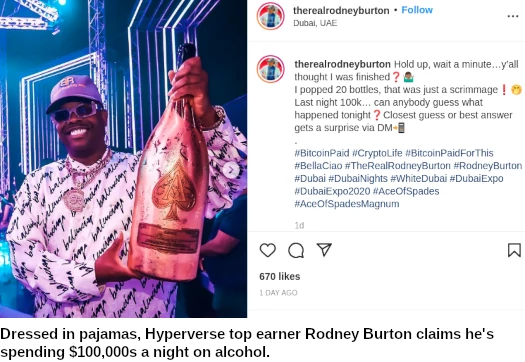
The DOJ claims Burton’s motion for release “does not identify any genuinely new, material information.” In contrast, there’s plenty of new information in the DOJ’s twenty-eight page filing.
It should be noted that the context for all this information is the aim to keep Burton locked up pending trial. Burton was arrested en route to Dubai, making him an obvious flight risk.
As the DOJ put it;
The Court found it “abundantly clear” that Burton intended to depart the United States to live permanently in Dubai before he was arrested, and also found it “abundantly clear” that Burton had an “intention to continue to engage in the business effort” related to the conduct for which he had been indicted.
Addressing Burton’s arguments for release, the DOJ first disputed Burton’s claim he’s no longer a flight risk;
Burton alleges three changed circumstances in support of his argument that he no longer has the means to be a flight risk:
(1) his passport has been confiscated;
(2) he sold his yacht; and
(3) his luxury vehicles have been seized or are heavily encumbered.
But none of this is new information. All three of these points were discussed at the July 2024 detention hearing and considered by the Court in ordering Burton detained.
The DOJ points out Burton’s own words kill his “confiscated” point;
In [a] recorded call that was played at [a] hearing, Burton bragged that he could travel to Dubai without a passport because Dubai would be implementing new facial recognition technology by Summer 2024.
(Burton: “You know what, the good thing is by this summer you won’t need a passport to go to Dubai. …Because your face will be your passport. You walk in and face recognition.”).
Furthermore, Burton acknowledges that he had a resident ID card for Dubai on his person when he was arrested.
There are many ways a person can escape the jurisdiction of the United States without an official U.S. passport.
As the Court correctly concluded in July 2024, the seizure of Burton’s passport does not adequately mitigate the risk that he will flee.
On Burton selling his yacht;
Burton’s lawyer argued at the previous detention hearing that Burton sold his yacht for roughly $850,000 in May 2024.
Now, as then, the government does not contest that Burton sold his yacht. As the Court pointed out at the detention hearing, however, the sale of the yacht made Burton “richer” than he was before.
As the Court recognized, as Burton sells off his assets in the United States, he becomes more—not less—of a flight risk because he has more liquid assets with which to pay for travel and accommodations abroad, and fewer physical assets tying him to the United States.
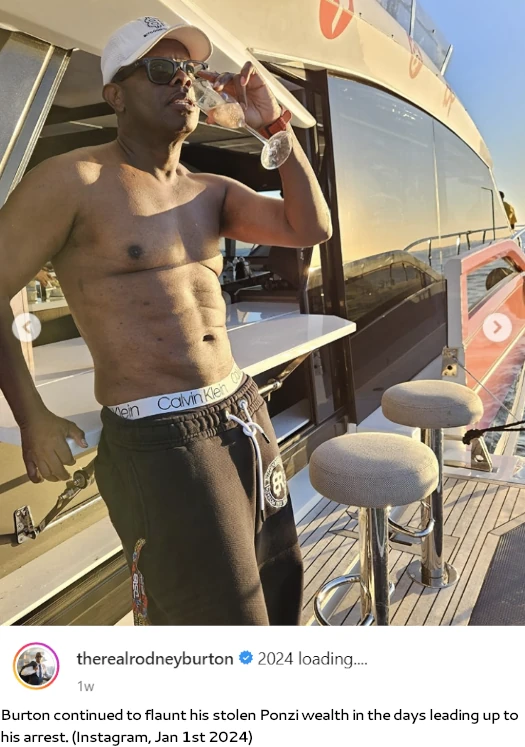
Although Burton now claims that the yacht was sold “at a loss,” he offers no proof of that claim, and it is contradicted by the record evidence.
Specifically, the Bill of Sale submitted at the previous detention hearing indicated that Burton owned 100% of the interest in
the vessel, and that it was being sold “free and clear of all liens, mortgages, and other encumbrances.”Furthermore, Burton’s TD Bank records, which have been turned over in discovery, demonstrate that he paid $1,417,000 to Marine Max LLC on October 12, 2021, with the memo line “Yacht Payment for Rodney Burton.”
That was not a loan—that was cash from Burton’s bank account. Analysis of Burton’s inflows and outflows establishes that it was paid for exclusively with HyperFund investor proceeds.
In other words, even if Burton sold the yacht for only $850,000 in May 2024, it was still $850,000 that he netted from the fraud scheme.
On Burton attempting to export his Rolls Royce to Dubai as part of his new life of crime;
It was the subject of much discussion at the previous detention hearing that U.S. Customs and Border Patrol intercepted an unmanifested Rolls Royce belonging to Burton on a container ship bound for Dubai in May 2024.
Burton now appears to claim the government was wrong, and CBP did not seize the Rolls Royce until November 2024.
According to Burton, since it was not seized until November 2024, that means he was not trying to liquidate assets by shipping them overseas.
Burton is wrong as to both the facts and their import. The Rolls Royce was first intercepted by the Savannah Anti-Terrorism Contraband Enforcement Team on March 29, 2024. It was turned over to CBP in or about May 2024.
CBP then obtained a seizure warrant for the Rolls Royce on November 19, 2024.
According to the CBP notification-of-seizure letter to Burton, the Rolls Royce was valued at approximately $436,500.
It appears CBP actually undervalued the Rolls Royce, because in a YouTube video posted in December 2023, Burton bragged that he had invested a total of $2 million in his custom Rolls Royce Cullinan.
Indeed, Burton’s bank records establish that Burton spent hundreds of thousands of dollars in HyperFund investor proceeds on custom upgrades for the Rolls Royce in 2021 and 2022.
Contrary to Burton’s assertion, this is clear evidence that even after his detention in this case, Burton was attempting to unlawfully smuggle ill-gotten gains overseas, outside the reach of U.S. law enforcement.
Burton also still has funds apparently still stashed away in Dubai bank accounts;
Burton’s bank records, which have been turned over in discovery, show transfers of money from Burton’s U.S. bank accounts to two different Dubai bank accounts registered to “Rodney Burton” and “RBJ Consulting” in May and November 2022.
The government has very limited visibility into these Dubai bank accounts. This factor, too, makes Burton a serious flight risk.
Another of Burton’s arguments was the DOJ’s inability to produce “evidence of hidden crypto wealth” since his arrest. On this the DOJ writes;
[Burton] is wrong.
Burton has publicly boasted of earning millions of dollars in cryptocurrency in YouTube and other social media videos that have been turned over in discovery.
His moniker during this fraud scheme was, after all, “Bitcoin Rodney.” In text messages from Burton’s cell phone dated May 2021, which have been turned over in discovery, Burton talked to a friend about what cryptocurrency wallets to use “to
stay anon[ymous] for tax purposes.”Burton said there were “tons” of these wallets and recommended “Trust wallet” and “Bitpay,” among others.
Furthermore, in electronic tablet messages since his incarceration at the Chesapeake Detention Facility, Burton has repeatedly alluded to his cryptocurrency holdings.
For example, on November 12, 2024, Burton messaged numerous people to celebrate that the Bitcoin price (abbreviated as “BTC”) had “hit 90k,” telling one of them, “boy am I happy.” Id. at 7. One person responded, “I pray it stays that high til you come home!” Id. On December 5, 2024, Burton messaged numerous people to celebrate that “BTC hits 101k.”
Burton also noted that “things are looking better” and “tell them to except [sic] payment in crypto.” Id. On December 7, 2024, Burton asked a friend to “keep me updated on the prices of Xrp, doge, ctc and shiba if u can. Thanks.”
Also in his CDF tablet messages, Burton has talked about spending large sums of money on lawyers for his defense.
For example, as recently January 23, 2025, Burton told a friend that he “hired new Attorneys in Texas and DC which cost me well over six figures and they are working on my current case.”
Burton’s complaint about the government’s lack of visibility into Burton’s cryptocurrency assets fails to acknowledge that cryptocurrency is different from other assets in critical respects.
It is frequently used in criminal transactions precisely because it is easy to hide, it is anonymous, and it can be facilitated instantaneously across borders.
In other words, although the government knows that Burton has substantial cryptocurrency assets based on his own statements, the government cannot effectively locate, monitor, or restrain how those cryptocurrency assets are
used.In any event, it does not require a great deal of money to board a bus to Mexico or even to hop on a flight to Dubai.
The DOJ challenges Burton’s assessment of him having less reason to flee given time in custody, citing the newly filed superseding indictment.
Burton’s December 10th superseding indictment additionally charges him with conspiracy to commit wire fraud, wire fraud and money laundering. Previous conspiracy to operate an unlicensed money transmitting business charges have been dropped.
If convicted, Burton faces maximum penalties of twenty years on the wire fraud conspiracy and wire fraud counts, and ten years on the money laundering counts.
Burton’s expected Sentencing Guidelines range if convicted of the wire fraud counts alone would conservatively be 135–168 months of incarceration.
Thus, Burton has even more reason to flee than he did when the Court detained him initially, when he was facing a maximum penalty of only five years.
The DOJ claims Burton was “on notice” about additional charges at the time of his “crime is legal” release filing.
The DOJ’s filing also provides some insight into the status of plea deal negotiations with Burton;
On July 21, 2025, the government conducted a “reverse proffer” for Burton and his attorneys, at which it outlined some of the evidence supporting these additional charges, and stated that it may seek a superseding indictment.
Over the next several months, the parties discussed a potential resolution to this matter. During those discussions, the government continued to inform defense counsel that the evidence supported additional, more serious charges.
Ultimately, the parties were unable to reach a plea agreement.
After plea discussions proved unsuccessful, the government sought a superseding indictment—as it repeatedly advised the defense it was likely to do.
The DOJ states that as of December 2025, Burton’s previously offered plea agreement is “no longer on the table”.
On Burton’s “crime is legal” arguments, the DOJ writes;
Burton next argues that release is warranted in light of the April 7, 2025, internal Department of Justice Memorandum from Deputy Attorney General Todd Blanche (the “Blanche Memo”), which relates to certain prosecutions under 18 U.S.C. § 1960(b)(1)(A) and (B).
Over the course of thirteen pages, Burton argues that this Memo represents a “policy shift[]” and that he would not have been charged following the publication of this Memo. Burton’s argument is meritless.
Again, this argument is largely mooted by the Superseding Indictment.
More fundamentally, the internal policy pronouncements in the Blanche Memo do not have a “material bearing on the issue whether there are conditions of release that will reasonably assure” Burton’s appearance.
The Blanche Memo guides and instructs Department of Justice prosecutors in making charging decisions relating to prosecutions involving digital assets.
The memo expressly states that it “does not, and may not be relied upon to create any right or benefit, substantive or procedural, enforceable at law or in equity by any party against the United States.”
Burton’s request that the Court leverage internal departmental guidance in this manner should be rejected.
The Blanche Memo instructs prosecutors to prioritize, among other things, “investigations and prosecutions that involve conduct victimizing investors, including embezzlement and misappropriation of customers’ funds on exchanges, digital asset investment scams, [and] fake digital asset development projects.”
This is just such a prosecution. Burton netted over $9 million by promoting a Ponzi scheme, receiving valuable U.S.
dollars from HyperFund investors and transmitting to them worthless fake cryptocurrency in exchange.
Although I’m aware of Burton’s prior drug distribution conviction, I haven’t really brought it up as, while it does speak to Burton’s character, MLM crypto investment fraud isn’t related.
The DOJ does bring up Burton’s prior conviction within the context of keeping him detained. And seeing as Burton started this argument, I think it’s fair to include the DOJ’s remarks on Burton’s prior conviction here.
Most importantly, this is not Burton’s first criminal offense. Burton has a prior federal conviction for conspiring to distribute cocaine, in violation of 21 U.S.C. § 846, for which he served five years in the Bureau of Prisons.
Burton acknowledges that he violated his conditions of release in that drug case by absconding from his home and being arrested for assault in a different jurisdiction.
That history of non-compliance with his conditions of release is strong evidence that he cannot be trusted on community supervision in this case.
Furthermore, Burton reported to pretrial officers in this District his use of cocaine on New Year’s Eve 2023—days before his arrest in early January 2024.
His admitted recent use of cocaine after a lengthy sentence for distributing cocaine refutes the notion that he has developed newfound respect for the law.
Although they are obviously dead in the water now, for the first time the DOJ has revealed what Burton had planned if he had of made it to Dubai.
In a recorded call in December 2023—which the Court listened to in full—Burton told a co-conspirator that he had flown to Malaysia to meet with [HyperFund co-founder Ryan] Xu, and Xu had agreed to make Burton the CEO of a new cryptocurrency company called Brainery in Dubai.
Burton acknowledged that Xu insisted on meeting in “private” and without “our phones in the room”—not exactly signs of an above-board business venture.
Burton’s description of Brainery in the call makes clear that it was another, similar Ponzi scheme; indeed, Burton admitted he had not “dug deep and investigated” the company’s claims about how it generated income … and he “had no idea if people are going to get hurt or not.”
The Court correctly concluded that Burton’s statements in this recorded phone call amounted to clear and convincing evidence that he posed a financial danger to the community.
Given his track record, there is every reason to believe Burton will continue to perpetrate fraud on the public if released.
On December 19th Burton made his initial appearance on the superseding indictment. Burton pled not guilty to all charges.
Later that same day the court held a hearing on Burton’s motion for release. The docket entry for the hearing is sealed. There is also no accompanying hearing order on the docket.
Given there’s no order for Burton’s release, pending further updates from the court I think it’s safe to assume Burton remains in custody.
A second order, made later still on December 19th, reschedules Burton’s March 2026 trial to June 2026. The order states the rescheduling was agreed upon at the December 19th motion for release hearing.
Update 25th December 2025 – Rodney Burton’s third bid for pre-trial release has been denied.
