
MLM Compensation Plans: The Matrix Model
Out of all MLM compensation plans, the matrix model (also known as the forced matrix) is probably the simplest to understand. Looking, dare I say it, somewhat like a pyramid you start off at the top of your matrix and as you grow your organisation fill in allocated spots below you.
There are of course slight variations that can be applied to the matrix model but overall the functionality is virtually the same. As your organisation grows the levels of your matrix increase and these levels provide you with residual income. This residual income is paid out in commissions via the product sales or recruitment those in your organisation achieve.
Your basic matrix model for an MLM compensation plan involves two size factors, A x B.
A is your frontline and is the number of levels wide your matrix is. It is comprised of members you personally recruit into your organisation.
B is also a number and is the number of levels deep your matrix is. Some compensation plans cap this number whilst others don’t.
Your standard MLM compensation plan matrix looks something like this:
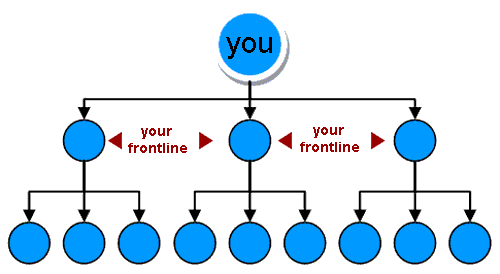
The above is a 3X2 (2 levels deep and three levels wide) matrix and is a simple example. More complex matrix models can extend infinitely wide and deep or have limitations placed on the size so as to either force a matrix cycle or cap commission payouts.
The two biggest variations in matrix models are whether or not the matrix is fixed or not
The fixed matrix model
The fixed matrix model places limitations on your standard matrix, usually in the form of size restrictions. Typically there will be a cap in the form of A x B so as to trigger a cycle event.
A cycle is what happens when the matrix fills up and typically involves the person at the top of the matrix ‘cycling’ out and being rewarded with a commission payment.
After cycling the member is then placed into another existing matrix within the company, or at the top of a new fixed matrix. From here the member attempts to fill up the matrix again for another commission payout.
Fixed matrices are usually capped at small numbers (2 x 3 or 2 x 2 are quite common) so as to reward regular commission payouts for those who mass recruit into the business.
Due to the nature of the fixed model it is commonly affected by what’s called spillover. I’ll explain spillover a little later but the gist of it is your matrix can be faster filled off the work of your upline or those above you in a fixed matrix.
The standard matrix model
This standard variation of the matrix compensation model is a lot freer in that there are no restrictions on the width and depth of the matrix you create. Each person on your frontline spawns off an independent branch of your matrix and over time the idea is to grow these branches several levels deep.
Due to there being no restrictions on the size of your matrix, you can have as many people on your frontline and grow your organisation as many levels deep as you can achieve.
The standard matrix compensation model isn’t affected by spillover as each branch under your frontline run independent of each other. Because of this the unfixed matrix model initially relies more heavily on your own ability to fill it with recruits. In this sense team leverage is diminished in the early stages of building your organisation.
What is spillover?
When you join an MLM company with a fixed matrix compensation plan model, you’re placed at the top of a new matrix. This matrix however is a branch of your upline’s matrix, which in turn is a branch of their upline.
Spillover is what happens when someone above you in a parent matrix fills up a spot on their matrix which corresponds to a spot in your downline on your matrix.
Say for example you’re on the frontline of your uplines fixed matrix and your upline fills their frontline. The next level down (the frontline of your matrix) can then be filled over time by the recruiting efforts of your upline as they fill up the other levels of their own matrix.
Here’s an example;
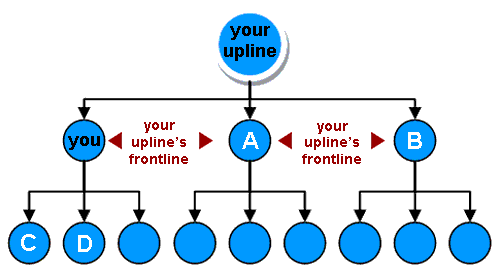
In the above matrix you can see how your own matrix fits in with that of your upline. For spillover to occur, let’s say your upline has filled their frontline (spots A and B), which you are on.
You directly recruit someone to spot C and then your upline manages to recruit another member. Due to your frontline being on their matrix spot D is filled via your upline. Spot D being filled affects both your own frontline and the matrix of your upline.
This affect is called spillover and requires no effort on your part to fill a spot on your own fixed matrix.
Final Thoughts
Due to the simplicity of the matrix model it is quite popular with new MLM company startups. Unfortunately due to the reliance of recruitment as a primary factor in commission payouts there is a very real danger of recruitment becoming a primary objective for the new distributor. This in turn takes away from retail product sales and at the extreme level, from the product altogether.
Obviously each MLM company is different in this regard and prospective member’s really need to do their research on each business opportunity they are contemplating.
One simple way to establish how your potential upline runs their business is to ask yourself were you shown the business opportunity or the product first?
That should give you a decent enough indication of what the primary focus of the business is, recruitment or sales. Be aware that if it’s recruitment this is typically unsustainable and you could be joining a short lived money exchange operation.
As always, research, research, research. And then research some more. Good luck!

Can you help me, my friend wants me to join ashmax – do you think its a scam?
Hi Kelly. I haven’t looked into Ashmax but I had a brief poke around and it seems to be a 5×5 matrix based marketing platform for Global Domains International (GDI).
GDI seem to be an MLM company focusing around the sale of domain names and web services. Not too sure why I’d want to buy a domain from a MLM company though…
Ashmax is another company that the dodgy Kaz Spence is involved in.
https://behindmlm.com/companies/polaris-media-group/kaz-spence-comes-clean-about-pmg-polaris-global/.
So; one would expect it is just another money making scam.
Is Forever Living Products a similar scam? What type of MLM company are they?
Hi Susan, I haven’t had an indepth look at them but at a glimpse Forever Living Products appears to be a product based MLM, rather then a recruitment based one.
This is a good sign but without going further into the business I can’t really comment on what kind of MLM company they are. They do appear to have been around for a while though which is another good sign.
I’ve added FLP to my research list so I’ll get around to researching them eventually.
just want to share this with you, I work in a MLM company that pays 50% to he field, would you like to know how it pays and how much ???
Sure… why not?
@Susan.
Hi Susan FLP has been doing business for over 30years now, so You can trust them.
Read about them at my site or on foreverliving.com
Regards Peter in Seden.
The age means nothing. Bernie Madoff’s scheme was alive for at least TEN YEARS, possibly more. Heck, he was head of NASDAQ at one time.
can mlm comp plan work if you only have one product to sell
Depends on the product and the market for it (and how much of it you can actually reach).
Product may be unique, wanted by some people, and profitable, and perhaps even great, but if you can’t REACH the prospective buyers with the marketing methods/budget you have it will NOT be profitable to you.
I’ve seen people sell Xango (to humor them, as it’s my aunt’s friend, I actually bought a case) Way too overpriced for juice with pulp and the supposed benefits. That’s a one-product company, pretty much.
@val
I don’t see why not. The product viability ensures the success of the marketers which in turn ensures the success of the compensation plan.
Whether there’s one product or ten, if they’re viable and in demand then I don’t see why things shouldn’t work out.
Hi what do you think if the truestar matrix comp plan?
Depends if they’re selling memberships or actual products. I haven’t looked at Truestar but I’ll add them to my review list.
If I’m not wrong (that is what I understood from reading the entire article), the first image of the article looks like a 3×2 matrix. Am I right ?
That it is, good pickup two and a half years from when I first published the article! 🙂
What type of matrix a party plan uses. My wife its about to join one partyplan business and I do not understand how they work or where the commisions are redistribuited.
Can you explain?
I’m not too sure what a “party plan” is.
Typically with an MLM compensation structure it has positions that need to be filled. These positions are filled with recruited affiliates (either directly or indirectly) and commissions are usually paid monthly.
These commissions are typically sourced from monthly membership fees although they can be sourced from a mandatory monthly product purchase.
hey oz i follow your posts all the time all great i would like to get your advise on a company called WakeUpNow do you made a review on it ?? a friend is asking me to join it but im scared it could be a scam, if any toughts let me know thanks take care.
Here’s 2 articles, found by using the “Search” function in the upper right area of this website (it may be blocked by some ad-block programs):
https://behindmlm.com/companies/that-free-thing/wakeupnow-review-simple-idea-complex-commissions/
https://behindmlm.com/companies/that-free-thing/wakeupnow-to-enforce-mandatory-retail-sales-quota/
The second link is disabled to avoid moderation queue. Just copy / paste it if you want to read that article.
Hi Oz, I disagree with you. The Single Line or Monoline Compensation Plan is the Simplest to Understand and Practise.
It’s also the most prone to stalling due to the regular abuse of combining it with the selling of positions (cycler).
@UBs please research, WUN sues Kirby Cochran for $70+Million… Idk where imma slept tonight, lost interest… Lol.
I find your site interesting in being analytical so i ask a question which some companies refuse to answer and i wonder why.
In a 2 x 5 matrix where first level is filled with two then that person goes to a new matrix to fill with four spots to fill that second level of four does that require 8 new people coming in and say to fill the 3rd level of 8 does that require a group of 64 coming in to complete that level.
As each level fills the entry dollar value is increased so it is not a straight forward matrix as in 2 x 4 x 8 each line is seperate so im guessing the numbers grow Larger each time Hope you can help me. There are a couple of business matrix scams that work like this such as My Complete Business and Passive cash.
Why i am asking is I am trying to educate people it takes a lot of people to fill these programs to get to the big dollar level Regards Roy.
@Roy
If there’s a fee attached to unlocking a new matrix level then existing affiliates are recycled.
If it’s a straight matrix fill from top to bottom (one-time fee) then it’s all new affiliates required to fill it.
I’d like to ask. Which MLM model fits best for an online store, and why?
Thanks
The MLM model is used to determine commissions. An online store needs to focus on generating retail sales.
An MLM compensation plan isn’t going to generate retail sales for an online store, so which model you use doesn’t matter.
Aloha: I’m considering selling my healing service as a 3 level MLM —-is there someone I can communicate with (Consultant) that can advise me the best way to position my marketing and best–payout.
Mahalo, Craig
Hi Craig, BehindMLM doesn’t offer consulting.
I’m not sure what a “healing service” is but I’d be looking at regulations (FDA/FTC) before proceeding.