
DeNet Review: Datakeeper node securities fraud
 DeNet fails to provide ownership or executive information on its website.
A September 2021 press-release identifies Russian nationals Rafik Singatullin (CEO) and Denis Shelestov (CTO) as DeNet executives.
A Bitcoin WIKI entry cites Singatullin and Shelestov as two of four DeNet co-founders; the other two being Olga Belonozhko and Pavel Litviakov (aka Paul Litviakov).
As per respective social media profiles, DeNet’s co-founders are based in Dubai, Russia, Singapore and Switzerland:
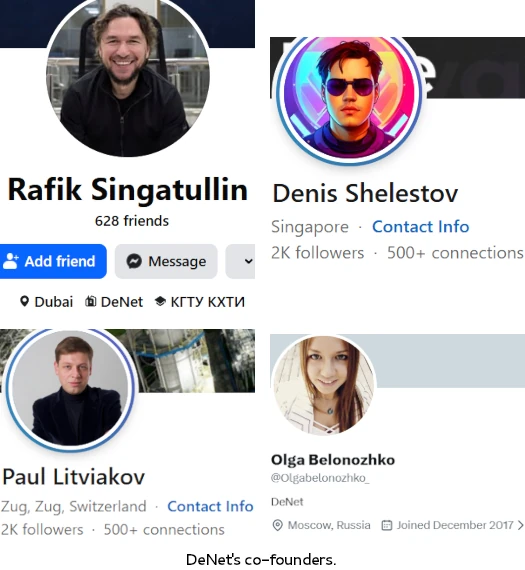
Note that while he co-founded DeNet, Pavel Litviakov seems to have moved on.
DeNet operates from two known website domains:
- denet.pro – registered in July 2017, private registration last updated May 31st, 2024
- denet.app – registered April 29th, 2024, private registration last updated October 10th, 2025
DeNet doesn’t provide a corporate address on its websites. In an official “media kit” available on DeNet’s website, it claims to be a “Hong Kong-based Company with a development back-office in Kazan (Russia)”.
Search results suggest DeNet is based out of Dubai:
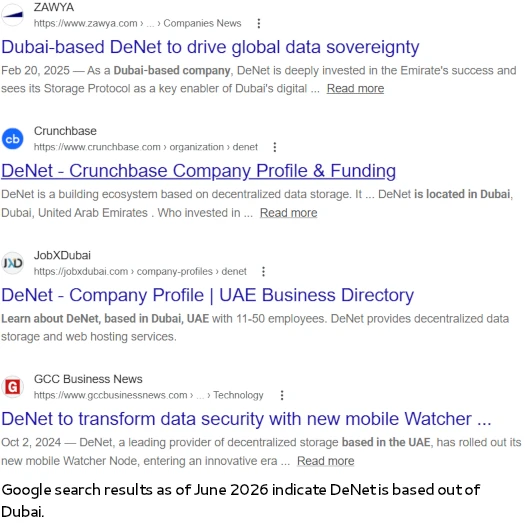
This ties into CEO Rafik Singatullin also being based out of Dubai, a due-diligence red flag in and of itself.
Due to the proliferation of scams and failure to enforce securities fraud regulation, BehindMLM ranks Dubai as the MLM crime capital of the world.
BehindMLM’s guidelines for Dubai are:
- If someone lives in Dubai and approaches you about an MLM opportunity, they’re trying to scam you.
- If an MLM company is based out of or represents it has ties to Dubai, it’s a scam.
If you want to know specifically how this applies to DeNet, read on for a full review.
DeNet’s Products
With respect to its MLM opportunity, DeNet has no retailable products or services.
Promoters are only able to market DeNet promoter membership itself.
DeNet’s Compensation Plan
DeNet promoters invest in “datakeeper node” positions for $580 each.
To activate a datakeeper node position, a DeNet investor has to grant access to storage space on a device they own.
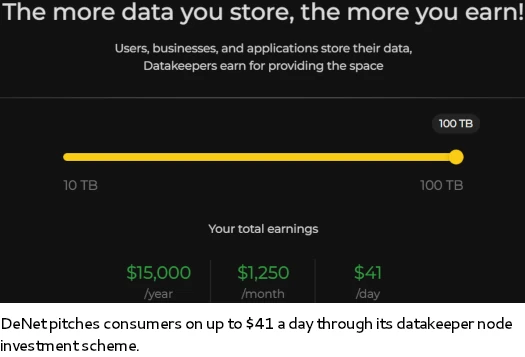
A ROI calculator on DeNet’s website starts at 10 terabytes (TB) of allocated storage paying $4 a day. This scales to $41 a day for 100 TB of allocated storage.
The MLM side of DeNet pays on datakeeper node investment down three levels of recruitment (unilevel):
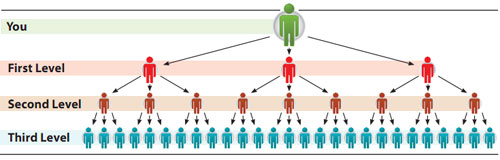
- level 1 (personally recruited promoters) – 20%
- level 2 – 5%
- level 3 – 1%
Note that datakeeper node returns and MLM commissions are paid in WN, an internal token owned and created by DeNet.
DeNet doesn’t disclose the internal WN value on its website.
Joining DeNet
DeNet promoter membership is free.
Full participation in the attached income opportunity requires at least one $580 datakeeper node investment position.
DeNet Conclusion
First, the obvious; From a security standpoint it’s probably not a good idea to allocate terabytes of your storage to Russians in Dubai and other hidey-holes.
DeNet was launched by optimistic teenagers around the peak 2017 crypto hype bubble.
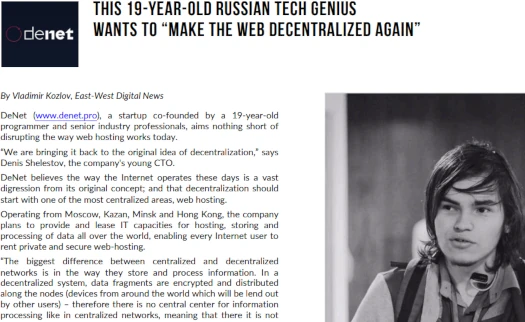
As detailed in a February 2018 research report from East-West digital news (pg. 33);
DeNet, a startup co-founded by a 19-year-old programmer and senior industry professionals, aims nothing short of disrupting the way web hosting works today.
Operating from Moscow, Kazan, Minsk and Hong Kong, the company plans to provide and lease IT capacities for hosting, storing and processing of data all over the world, enabling every Internet user to
rent private and secure web-hosting.The initial investment in the project was a mere $10,000, which the founders took out of their own pockets.
That amount allowed the startup to set up offices and hire personnel in May 2017.
Another investment round with an undisclosed amount enabled the startup to accelerate R&D and
support its first branding and marketing campaigns.
Like every crypto project at the time, DeNet held a token ICO.
DNET was an ERC-20 token that launched in late 2018 with a typical pump and dump trajectory.
After DNET came DE and TBY tokens, which don’t exist outside of DeNet. On top of DE and TBY there’s also PEAQ and WN, the latter of which is used for the MLM investment scheme.
DeNet is a classic “solution looking for a problem” crypto business. And that’s reflected in the lack of retail adoption after nine years.
As of April 2026, SimilarWeb was tracking just ~8000 monthly visits to DeNet’s primary .PRO website. I’m pretty confident most of that traffic is related to the datakeeper node scheme as opposed to genuine retail interest in file hosting.
DeNet began preselling datakeeper node investment positions in April 2025, with functionality remaining unclear through June 2026 (but new investment still solicited).
The problem with DeNet’s datakeeper node scheme is failure to register with financial regulators. Per the Howey Test, DeNet’s datakeeper node scheme is clearly an investment contract.
Consumers invest in $580 positions on the promise of passive returns, derived passively through DeNet’s purported decentralized file hosting network.
Conceptually WN token withdrawals would be funded by file hosting customers, however DeNet seems to promise earnings regardless.
Notwithstanding consumers doing due-diligence have no audited financial reports to verify DeNet’s external revenue representations with.
In addition to failure to register with financial regulators, not filing the audited financial reports constitutes securities fraud.
There’s also no true retail datakeeper node investment option, meaning MLM commissions paid out on these positions is tied pyramid recruitment.
Securities fraud is of course illegal and typically when it comes to MLM, is indicative of a Ponzi scheme.
If DeNet pays WN token withdrawals with node investment fees, even partially, that would be a Ponzi scheme.
I’m putting a question mark on this as $580 per position at $4 to $41 a day isn’t going to go far.
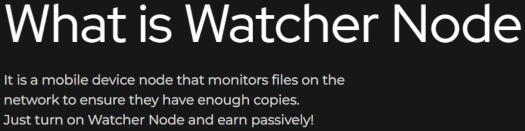
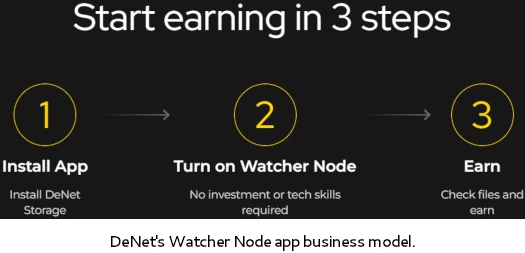
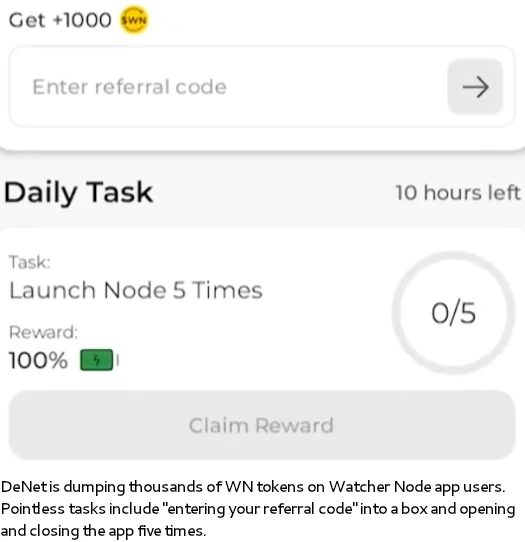
DeNet also offers a “Watcher Node” app, through which WN tokens can be earned by just running the app.
I’m inclined to think WN token itself is near worthless as a result, but that doesn’t really matter as DeNet quote USD in their datakeep node ROI calculator.
Whatever WN’s internal token value is, DeNet still has to pay $4 to $41 a day, unless their also misrepresenting ROI amounts on their website.
Either way, crypto usually doesn’t make much sense when it comes to math anway.
Regardless of whether it’s a Ponzi scheme or not, securities fraud and pyramid recruitment are reasons enough to steer clear of DeNet.
